

You've poured a good whiskey over a fresh large ice cube, watched it crack in the first minute, and tasted a drink that's watery before you're halfway through. The cube looked right. The result didn't. That gap usually comes from size, freezer temperature, or handling, not from whether the ice is perfectly clear. Judge each batch by melt rate and food safety first, and clarity last.
Table of Contents
- Pick the Right Cube Size for Each Drink
- Clear Ice Methods Compared by Effort and Result
- How to Make Clear Large Ice Cubes at Home
- Fixing Cloudy, Cracked or Weak Cubes
- Serving and Storing Large Cubes Safely
Pick the Right Cube Size for Each Drink
Choose the cube before you touch a mold. Surface-to-volume ratio does the work here. As a cube grows, its volume rises faster than its exposed surface, so a smaller share of the ice meets warm liquid at any moment.
| Cube size (per side) | Volume | Surface-to-volume ratio (per inch) | Best use |
|---|---|---|---|
| 1 inch | 1 cubic inch | 6 | Highballs and fast chilling |
| 1.5 inches | 3.4 cubic inches | 4 | Rocks glasses and mixed drinks |
| 2 inches | 8 cubic inches | 3 | Spirit-forward drinks and slow sipping |
| 3 inches | 27 cubic inches | 2 | Single large serves |
You can also fit a 2.5 inch cube, at 15.6 cubic inches with a ratio of 2.4, into a wide glass for a long pour. I would start most home bars with 1.5 inches and 2 inches, because those two sizes cover mixed drinks and spirit-forward sipping without forcing oversized glassware.
What the melt benchmark actually tells you
The geometry shows up in timed melting. The Wiley experiment on cube melting time found that increasing dimensions from 20 × 20 × 20 millimeters to 45 × 45 × 45 millimeters increased total melting time from 1,205 seconds, about 20.1 minutes, to 1,523 seconds, about 25.4 minutes, an increase of about 26.4%. Treat that as a benchmark, not a promise for your glass. Shape, starting temperature, water movement, and density all shift the outcome.
Practical rule: Pick size for time and dilution, not for looks. A cube that survives a slow drink but warms it too little has failed just as clearly as one that disappears.
Match dilution to the drink
A large ice cube doesn't automatically mean less dilution. Recent beverage commentary on ice shape and dilution notes that shape and size alone don't determine melting, because starting temperature, movement, and time in the glass also matter. A warm cube, warm glass, hot room, repeated swirling, or a long serve can erase most of the size advantage.
- Highballs: Use 1 inch cubes when you want rapid chilling and a drink that opens up quickly, accepting faster dilution as the price.
- Mixed drinks in rocks glasses: Use 1.5 inches when the glass is narrower or when you still want steady chilling.
- Spirit-forward slow sipping: Use 2 inches for drinks such as an Old Fashioned or Manhattan, where gradual dilution protects the spirit. A garnish such as Hotel Starlino Maraschino Cherries, Italian cherries preserved in Marasca cherry juice with a rich fruit flavor and glossy finish, belongs with that style of serve.
- Stirred drinks: A dirty martini gets much of its dilution during stirring, so the cube in the glass should mainly chill. The bartending cheat sheet is a useful reference for keeping those build steps straight.
- Shaken drinks: These usually arrive already chilled and diluted, and many need no large cube at all.
If you're building a stirred setup, we sell the A Bar Above Stirred Cocktail Set, stainless steel with 10 pieces, for $54.00. That's separate from the ice decision. The tools won't fix a warm glass or an undersized cube.
Pre-chill the glass, decide how much dilution the drink needs, and then add the cube. Your final check is fit. The cube should fill most of the base without wedging against the sides or sitting up near the rim.
Clear Ice Methods Compared by Effort and Result
For a quick drink, a cloudy cube that chills reliably beats a clear cube that took more work than the occasion required. Choose a method by the balance of melt rate, food safety, time, and effort. Clarity is secondary.
| Method | Equipment | Clarity result | Effort | Best for |
|---|---|---|---|---|
| Standard silicone mold | Silicone mold, filtered water, home freezer | Cloudy center | Low | Quick large cubes for a home bar |
| Boiled and cooled water | Kettle, sealed container, silicone mold | Fewer bubbles, less cloudiness | Medium | Cocktail service where ice is visible |
| Directional freezing | Insulated cooler, mold or tray, filtered water | Clear body after cutting away cloudy top and bottom | Medium to high, one to two days | Clear cubes for serving |
| Block cutting | Cooler, hand saw or ice pick, clean cutting surface | Clearest, precise shape | High | Hosts who need many clear cubes |
Decision rules for each method
Standard silicone mold. Choose this for convenience. A cloudy center is a cosmetic drawback, not a reason to reject a cube that fits the glass and chills the drink as intended.
Boiled and cooled water. Choose this to reduce bubbles without adding a cooler setup. It can reduce cloudiness, but it does not guarantee a clear cube. Keep the water covered as it cools and pour gently.
Directional freezing. Choose this when a clearer serving cube is worth the extra time and trimming. The method leaves a portion of the ice to discard, so it makes less usable ice than filling a mold and freezing it directly.
Block cutting. Choose this when you need several cubes to a consistent shape and have the tools and workspace to cut safely. It takes the most handling, and a slip with a saw or ice pick can injure you. Keep the cutting surface stable and move the tool away from your body.
Fresh cut surfaces are food-contact surfaces. Handle a trimmed cube with the same care as a garnish going straight into a guest's glass.
For a home bar, start with a silicone mold and boiled, cooled water. Move to directional freezing only when a clearer cube justifies the added time and ice loss. For an elegant aperitivo at home, choose the simplest method that gives you a clean, safely handled cube suited to the drink.
How to Make Clear Large Ice Cubes at Home
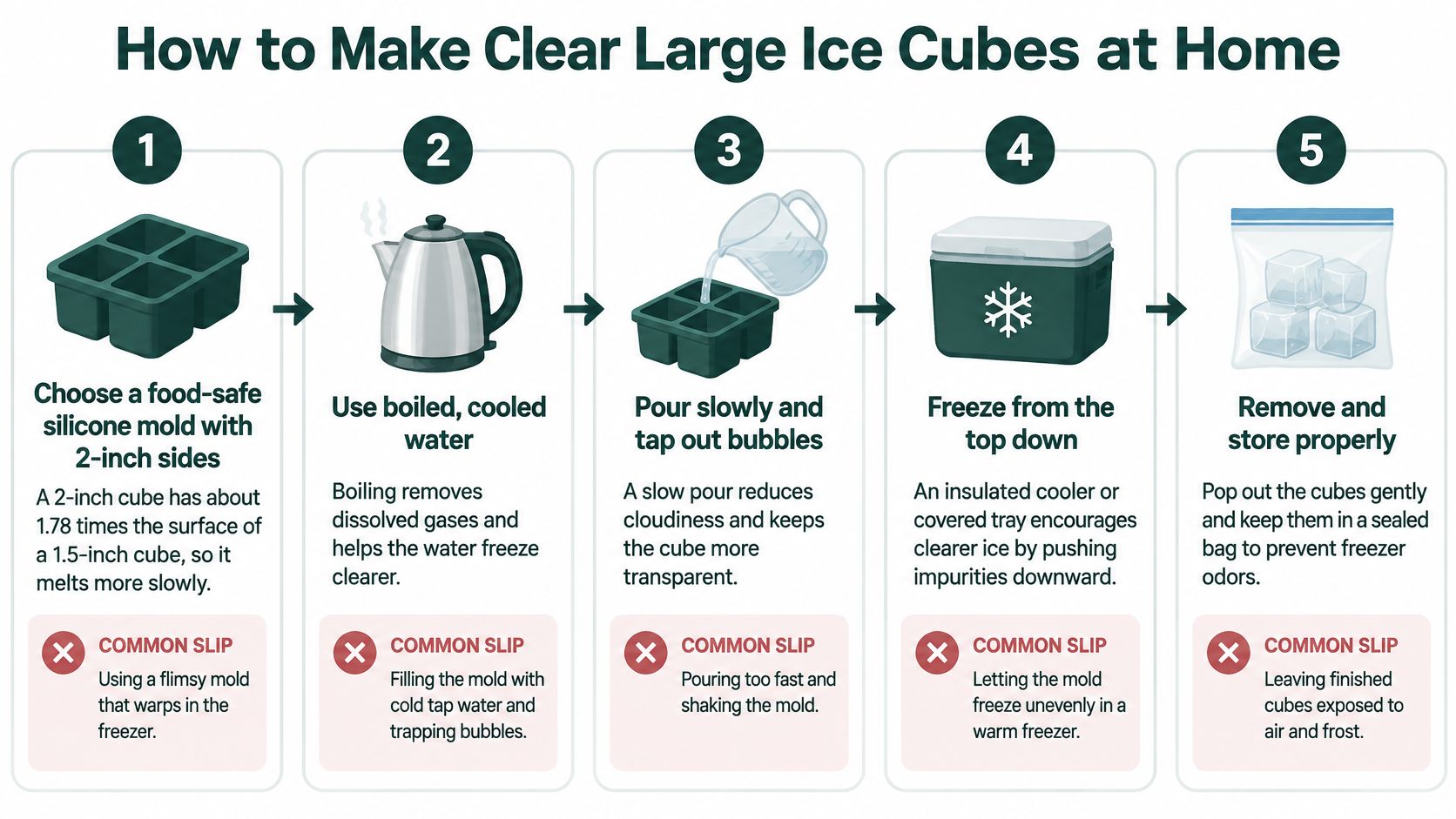
For a drink served on one large cube, the practical test is whether the ice chills the drink without diluting it too quickly. Clarity is secondary. Start with a sturdy, food-safe silicone mold, a kettle, a freezer thermometer, food-safe tongs, and a kitchen scale. Add an insulated cooler only if you plan to freeze directionally. Flimsy molds can bow as the water expands, leaving uneven edges that melt faster.
- Choose a 2-inch mold. It suits many spirit-forward drinks, provided the cube fits the glass. Compared with a 1.5-inch cube, a 2-inch cube has about 2.37 times the volume and 1.78 times the surface area, based on a calculation from the dimensions. That difference can slow dilution under comparable conditions. Use drinking-quality water and keep the freezer at 0°F (-18°C) or below, consistent with FDA food-storage guidance.
- Fill the mold carefully. Pour slowly and stop just below the top. Water expands as it freezes, so overfilling can create weak fins or distort the cube. A gentle tap can release visible bubbles.
- Freeze until solid. Leave the mold undisturbed for at least 24 hours. A hard surface does not guarantee a frozen center, so allow enough time for the whole cube to set.
- Temper before unmolding. Rest the mold briefly at room temperature, then flex the edges and lift the cube out without forcing it. This reduces stress on the ice. Avoid dropping a freezer-cold cube straight into a warm glass.
- Store sealed. Put finished cubes in a sealed freezer bag, press out excess air, and label the date if you are making them ahead. Open storage lets ice pick up freezer odors and surface frost.
Directional freezing for a clearer body
For directional freezing, set a filled mold or tray inside an insulated cooler with the lid off. Freeze for one to two days, then trim away the cloudy section with a clean knife or ice pick. Rinse the clear ice briefly with potable water and bag it promptly. A clean tool and careful handling matter because freshly cut ice is ready to touch the drink.
The video shows how to flex the mold and trim the ice.
Run a melt test before you repeat a batch
Weigh a cube, place it in a glass at a consistent starting temperature, and pour a measured drink. Record the elapsed time and weigh the remaining ice afterward. The result helps you judge whether the cube's size and preparation suit the drink. A mostly clear cube that holds its shape is useful, but a cloudy core is usually cosmetic if the ice performs well.
Fixing Cloudy, Cracked or Weak Cubes
A cube can look fine in the mold and still crack in the glass, stick when released, or dilute a drink too quickly. Match the fix to the failure: clarity is mostly cosmetic, while fractures, poor fit, fast melting and off flavors affect the serve.
| Symptom | Likely cause | Fix |
|---|---|---|
| Cloudy center | Gases and impurities concentrated in the last liquid to freeze | If the taste and melt rate are right, keep the cube; cloudiness alone is cosmetic |
| Cracks or fractures | Sudden temperature change between the cube, drink and glass | Let the cube rest briefly and pour gently |
| Melts too fast | Small cube, warm freezer or warm glass | Use 2-inch cubes, chill the glass and keep the freezer at 0°F (-18°C) or below |
| Mold sticks or breaks | Mold overfilled or cube not fully frozen | Leave headspace and freeze until fully solid |
| Off taste | Freezer odors or non-potable water | Use drinking water, wash the mold and store cubes in sealed bags |
| Cube does not fit the glass | Cube is larger than the glass opening | Use 1.5-inch cubes for rocks glasses |
Cracks and fractures
A very cold cube meeting warmer liquid or glass can develop stress lines. Let it rest briefly, pre-chill the glass and lower the cube into the drink rather than dropping it from a height. These small handling changes reduce sudden temperature shifts.
If a cube cracks into shards, remove it. Sharp fragments melt unevenly, make a mess of a slow drink and disrupt controlled dilution.
Fast melting, sticking and off flavors
If a cube melts too quickly, check the three points that affect the drink: cube size, freezer temperature and glass temperature. Verify the freezer with a thermometer, move up to 2 inches, and chill the glass before serving.
Sticking usually means the mold was overfilled or the cube was not fully frozen. Leave headspace and wait until the center is hard. Forcing out a soft cube can warp the mold and break off weak corners.
Off flavors point to the water, the mold or freezer odors. Use drinking water, wash the mold, seal finished cubes and keep them away from uncovered strong-smelling food. For a fit problem, switch to 1.5-inch cubes instead of forcing an oversized cube into a rocks glass.
Serving and Storing Large Cubes Safely
A cube can look perfectly clean and still pick up contamination during handling. Ice melts into the drink, so use potable water, clean tools, and containers intended for food.
- Start with potable water. The FDA's packaged ice safety guidance says ice used as food or as a cooling medium should be made from drinking water.
- Use clean tools. Transfer cubes with clean, non-breakable tongs or a dedicated scoop, not bare hands. Keep ice out of containers that previously held nonfood materials.
- Load only what you'll serve. Leave unused cubes in the freezer and bring out more as needed. A serving bowl left on the bar collects meltwater and warms the remaining ice.
- Keep meltwater away from ready-to-eat food. Drain display trays and replenish ice so garnishes do not sit in pooled water.
- Monitor perishable items separately. A large cube does not confirm that a garnish or drink component has stayed cold enough. Use a thermometer to check perishable items; judge the cube by its effect on dilution.
Cold presentation can disguise warm components in delicate drinks, including a lychee martini. Keep food safety and melt rate as separate checks.
Lello.Store curates cocktail garnishes, specialty pantry foods, and table essentials from small makers for home-bar service.