

What if the two words on the bag are both misleading you? Glutinous sweet rice flour isn't sweetened, and it doesn't contain gluten. Once you judge it by chew and cohesion instead of its name, choosing, mixing and substituting it gets much clearer.
Table of Contents
- What Glutinous Sweet Rice Flour Is and How It Compares
- Where Glutinous Rice Flour Appears in Recipes
- Check the Bag Before You Mix
- How to Mix and Cook a Glutinous Flour Dough
- Common Problems and How to Fix Them
- Substitutions When You Run Out
What Glutinous Sweet Rice Flour Is and How It Compares
The table below does the sorting first. Scan the amylose column, then the texture column, and you'll see why these flours can't trade places.
Glutinous and other flours compared on the criteria that matter in recipes
| Flour | Amylose share of starch | Texture after cooking | Typical uses | Gluten status |
|---|---|---|---|---|
| Glutinous sweet rice flour | about 1.0-2.3% | sticky, chewy, elastic | mochi, tangyuan, nian gao, rice cakes | grain without gluten; check labels |
| Regular long-grain white rice flour | about 15-25% | light, separate, crisp | noodles, batters, coatings, everyday cooking | grain without gluten; check labels |
| Brown rice flour | about 15-25% | grainy, nutty, denser | whole-grain baking, batters, flatbreads | grain without gluten; check labels |
| All-purpose wheat flour | not applicable (starch plus gluten) | elastic, structured, tender or chewy by method | breads, cakes, cookies, pastry | contains gluten |
What "sweet" and "glutinous" actually mean
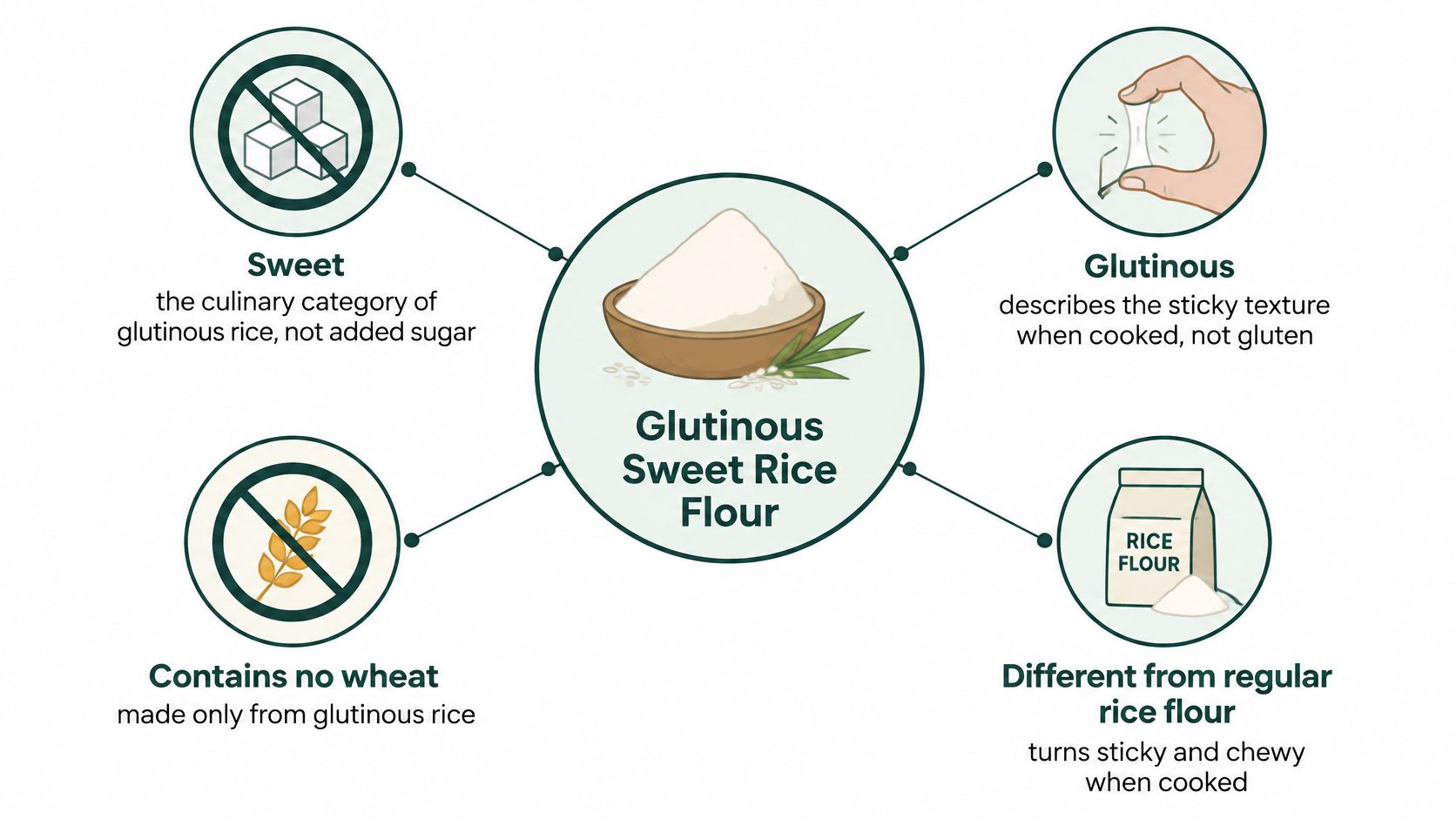
"Sweet" names the culinary category of glutinous rice. It signals the traditional sweet-rice group used for sticky cakes and dumplings, while the flour itself contributes no sweetness to a dough. If your recipe also calls for sugar, you still need that sugar.
"Glutinous" describes the sticky, glue-like texture the rice takes on when cooked. Wheat gluten is a separate protein system, and the word on a rice-flour bag points to cooked behaviour rather than to wheat protein. The USA Rice culinary classroom guide on rice types says glutinous, sweet and waxy rice flour is named for its sticky cooked texture, with little to no amylose.
So two separate questions hide behind one bag. First, is the grain itself free of wheat gluten? Yes, rice is. Second, was this particular packaged product protected from cross-contact during milling and packing? That's a label question, not a starch question, and it matters most if you cook for someone with celiac disease.
This diagram pulls the naming puzzle apart in one place.
The starch that does the work
Rice starch is built from two molecules. Amylose is a mostly straight chain. Amylopectin is highly branched, like a shrub with many limbs. The 2006 rheology study in the International Journal of Food Science and Technology describes glutinous rice starch as built almost entirely from amylopectin, while nonglutinous rice carries both amylopectin and amylose.
Measured glutinous flours sit at the low-amylose end of the ranges in the table. Carbohydrate does most of the compositional work, with small protein and fat fractions around it. That profile explains why the flour behaves like a texture tool: it supplies starch for cohesion, while flavour and browning usually come from fillings, sugars, oils or cooking method.
Those molecular shapes decide what happens in hot water. Straight amylose chains let cooked grains stay relatively separate and firm up as they cool. Branched amylopectin limbs tangle and hook onto their neighbours, so the paste pulls together into one cohesive, elastic, sticky mass. That's why glutinous sweet rice flour forms smooth, adhesive doughs instead of looser batters.
Practical rule: Choose this flour when a dish must stretch, hold a filling, or stay chewy. Choose something else when it must stay separate or crisp.
How to read the comparison
Regular long-grain white rice flour sits near 15 to 25% amylose, as shown in the table. That higher share keeps coatings light and noodles from collapsing into glue. Swapping in glutinous flour there gives you a dense, gummy coating that clings too well.
Brown rice flour changes the dish through bran more than through amylose. Its starch profile is closer to regular rice flour, while the bran shifts flavour and mouthfeel toward grainy, nutty and dense. Pick it for whole-grain character, then use a different tool when the target is clean stretch.
All-purpose wheat flour works in another system entirely. Its structure comes from gluten, a protein network you build by mixing and kneading. Rice flours have no such network to copy, so wheat flour can't reproduce mochi chew, and glutinous flour can't give you bread structure. Each does structural work the other can't.
For quick reference while you shop or plan, our culinary reference pages collect this kind of ingredient distinction in one place. Use the same order every time: read the recipe's texture target, check the bag's starch type, then confirm the label for cross-contact. When the goal is stretch, seal and lasting chew, glutinous sweet rice flour is the flour that matches the job.
Where Glutinous Rice Flour Appears in Recipes
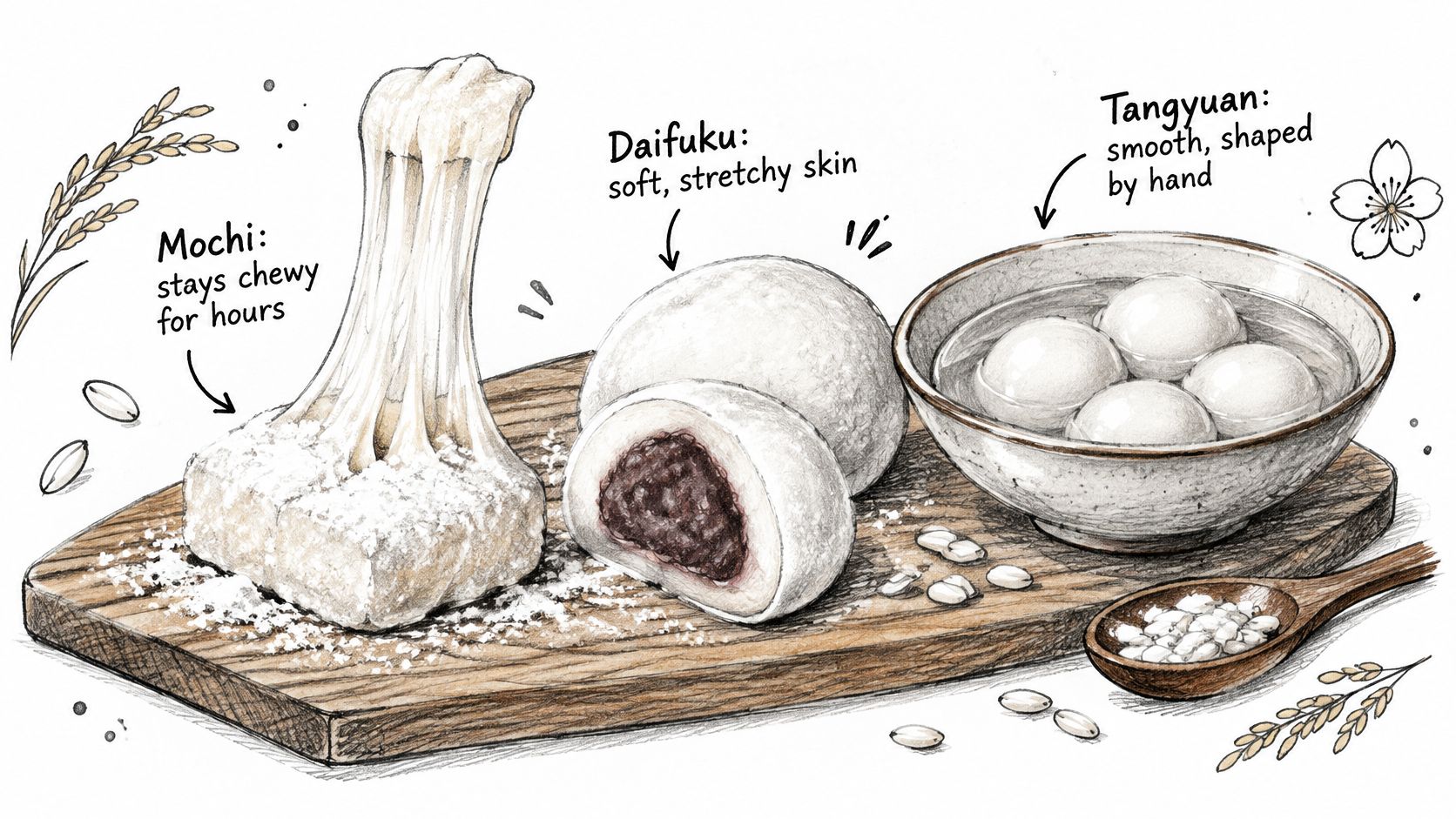
Say you're making mochi or daifuku. You need a soft skin that stretches around red bean or ice cream without tearing, then stays chewy for hours after shaping. Only a cohesive, elastic dough does that job, and the finished pieces get dusted so they don't stick to everything they touch.
Tangyuan ask for something slightly different. You roll a smooth dough into small balls, sometimes around a sesame or peanut filling, then boil them until they float. The dough has to hold together in agitated hot water, seal around a filling, and come out tender with a gentle pull. A loose flour would cloud the water and split.
The sweets below show that range of stretchy skins and tender boiled balls.
Nian gao, the sticky cake eaten during Chinese New Year, uses the flour as a pourable batter. Steamed or baked, it sets into a dense, sliceable block with a chewy crumb. Slices often go back into a hot pan afterward, where the interior softens again while the outside crisps, and the slice holds together through all of it.
Korean tteok and sesame-coated fried balls push the flour toward a firmer chew. The shell needs body around a filling and a bite that resists a little. Chewy cookies and blondies borrow the same pull in a Western format, adding bend and chew where wheat gluten would normally supply it. A spoonful of a ready filling such as Clément Faugier French Chestnut Cream, Crème de Marrons can also be tucked into a warm mochi-style wrapper for a simple filling.
The flour reaches past snacks built around chew. The 2024 study in Food and Machinery found that cakes containing 75% glutinous rice flour had the best overall taste and general preference among the tested formulations, so measured blends can earn a place in baking when you test them.
Some recipes work the other way. Crisp tempura-style coatings, thin crepes meant to stay delicate, and bakes that depend on a light, open crumb all fail with this flour. In each case, cohesion is the problem you are trying to avoid, and a less adhesive starch does the job better.
Check the Bag Before You Mix
Two bags can sit side by side on the same shelf, both labeled "rice flour," and behave like different ingredients in the bowl. One sets crisp and sandy. The other turns chewy and elastic under steam. A minute spent reading the label before checkout saves a wasted batch.
Confirm the name and the grind
- Look for the right names: Glutinous rice flour, sweet rice flour and mochiko all point to this flour family. Plain "rice flour" without one of those words is a different ingredient.
- Check the texture description: Fine, powdery flour hydrates smoothly for wrappers. Coarse, pebbly flour needs more time and water to dissolve.
- Read the date and storage note: Old, damp flour clumps and tastes stale, and our guide to understanding best-by dates on food packaging explains how to read those labels.
- Note the brand and lot: You'll want the same bag again if a test batch works.
Milling changes how a bag behaves, even when names match. A 1994 comparative analysis in Pertanika%20Apr.%201994/JTAS%20Vol.17%20(1)%201994%20(Page%207%20-%2012).pdf) of whole-milled, low-temperature impact-milled and roller-milled flour found starch values of 80.45%, 80.39% and 79.00%, with protein ranging from 7.5% to 8.4% and fat from 0.31% to 0.71%. In practical terms, hydration, smoothness and dough behaviour shift with processing, so two packages can perform differently in delicate dumplings.
"Gluten-free" on a label describes composition, not guaranteed manufacturing conditions. If you cook for someone with celiac disease, look for a certification or a clear manufacturer statement about cross-contact. On Lello.Store, ingredient and allergen information appears on the product page when the producer supplies it, and you can contact the shop before ordering if you need more manufacturer information.
Rice flour carries one more consideration: inorganic arsenic. Guidance generally favours eating a variety of grains. Rinsing and draining, the usual advice for whole rice, doesn't translate here, since you cannot rinse a milled flour. Check local guidance for infants, pregnancy or very frequent use, and treat this flour for what it is: a functional starch chosen for chew and cohesion, judged by the texture it produces rather than the claims on the front of the bag.
Store the opened bag airtight, cool and dry, away from strong smells. Then buy one bag, test one small batch, and write down the water amount and steaming time that worked. That note becomes your baseline the next time you shop.
How to Mix and Cook a Glutinous Flour Dough
This sequence works for a basic soft dough or pourable batter. Each step prevents a specific failure, so don't skip the early cold mixing to save a minute.
The visual summary below follows the same order you'll use at the counter.
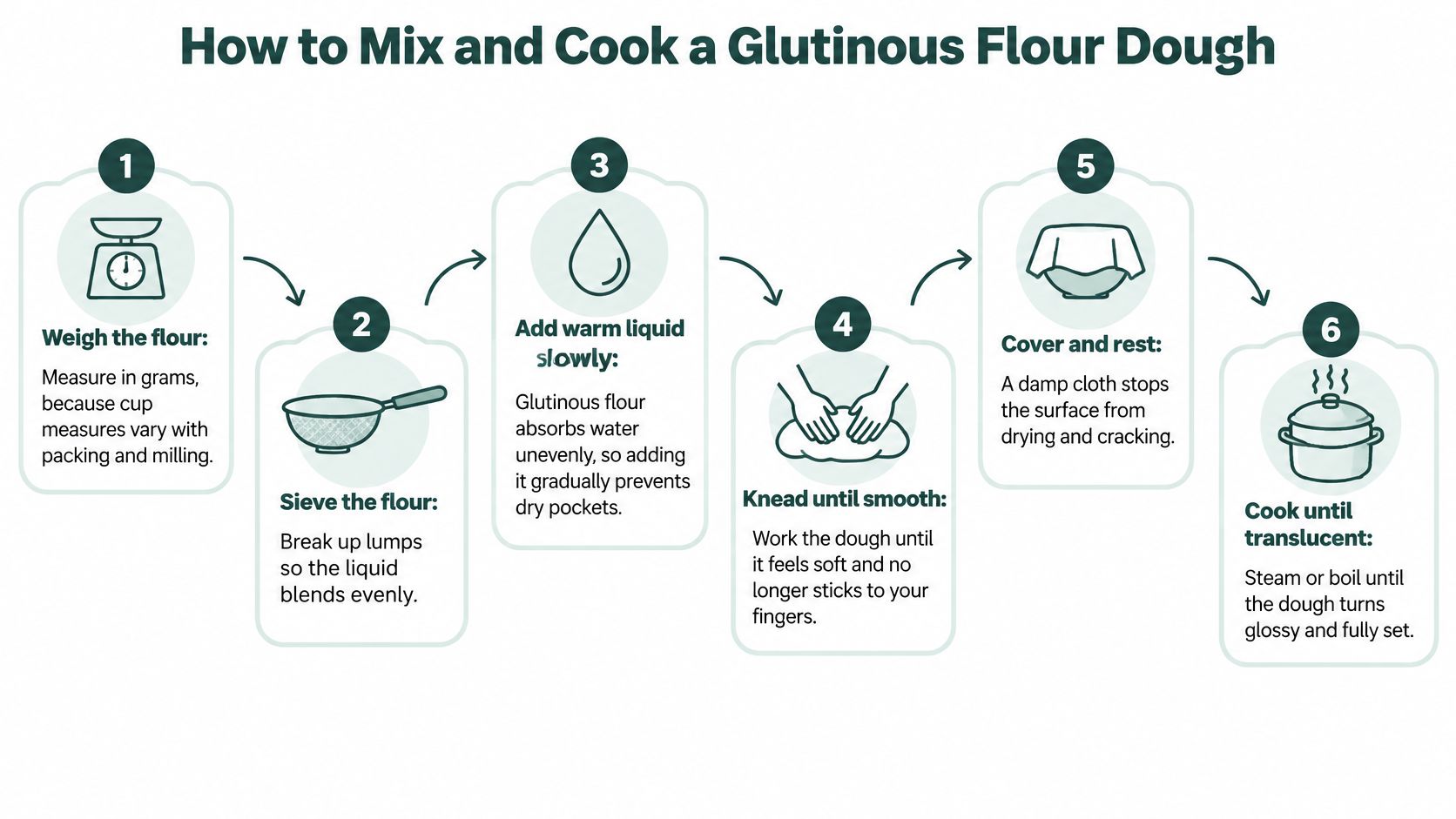
The eight steps
- Weigh the flour in grams. Cups vary with packing and milling, so a scoop can easily add too much flour. If your recipe mixes systems, our guide to US and European cooking measurements helps you convert before you start.
- Sieve the flour. This breaks storage lumps while they're still dry and easy to crush. A lump that survives into hot liquid becomes a sealed pocket you can't stir out.
- Whisk with a portion of cold water into a slurry. Cold liquid lets every particle get wet before starch swelling begins. Stir until no dry streaks remain at the bottom of the bowl.
- Add the remaining warm water gradually. Pour in stages, stirring between additions, until you have a smooth pourable batter or a soft dough. Glutinous flour absorbs unevenly at first, so patience here prevents dry pockets later.
- Rest 10 to 15 minutes, covered. Hydration finishes during the rest, and a damp cloth or lid stops the surface drying and cracking. You'll notice the mixture feels more uniform when you return.
- Heat gently by steaming or simmering. Move steadily through the temperature window where thickening accelerates, and check the centre for a dry or gritty core. Stir batters so the bottom doesn't set while the top stays raw.
- Knead or stir while warm. Work the dough until smooth and elastic, dusting the board and your hands with cornstarch to control sticking. Warm dough stretches. Cold dough tears.
- Test before shaping everything. Pinch off a piece. It should be smooth, elastic and free of dry specks, and it should stretch a little before breaking.
Cook by texture, not only by the clock. Smooth, glossy and elastic with no chalky centre is the endpoint you're looking for.
Why the temperature range matters
The flour must be fully dispersed before heating, then cooked through gelatinization to develop binding power. Across 29 glutinous-rice varieties, the study in Foods on gelatinization across glutinous varieties reported gelatinization onset temperatures from 62.54 to 76.91 °C and conclusion temperatures from 77.92 to 88.18 °C. Your cooking therefore has to run long enough to pass the upper part of that range, not just reach the point where thickening starts.
In practical terms, insufficient heating leaves a gritty, weakly bound centre even when the outside looks done. Adequate water and thermal exposure let the branched starch swell and produce that dense, cohesive paste. Cultivar differences shift the exact behaviour, which is why a new brand may need slightly more or less water or a few more minutes of steam.
Watch the mixing and warming stage done in real time before your first batch.
Adjust in small moves. Add water by the spoonful, extend steaming briefly, then test again. One recorded test batch teaches you more about your bag than any generic ratio can.
Common Problems and How to Fix Them
A gritty centre usually means the flour never hydrated. A dough that cracks when you fold it points to too little water, and a sticky mass that refuses to firm up points to too much. Match the symptom you can see or feel to the table below, then try the first fix before changing anything else.
Glutinous flour problems, causes and fixes
| Symptom | Likely cause | Fix |
|---|---|---|
| Gritty or chalky centre | flour not fully hydrated before heating | whisk with cold liquid first, rest 10-15 minutes, heat gradually |
| Dense, gummy or overly sticky | too much water or flour packed into the measure | weigh the flour and add water in small amounts |
| Dry, crumbly dough that will not bind | too little water or coarse flour | add warm water a tablespoon at a time and sieve the flour |
| Lumps after mixing | flour added to hot liquid all at once | sieve first, blend with cold liquid, then add the rest in portions |
| Tough or rubbery once cooled | overcooked or left too long before eating | eat soon after cooking or steam briefly to soften |
| Hard within a day | starch firming as it cools, faster in the fridge | store airtight at room temperature and re-steam before serving |
The causes behind most failures
Water reaching the flour before heat does explains gritty centres and many lumps, and the remedy is the same sequence from the mixing steps: sieve, blend with cold liquid, then heat gradually. When hot liquid hits dry flour, the surface of each clump gelatinizes into a shell that keeps the core dry. Stirring harder after that point mostly moves the lumps around.
Water amount and measuring explain the swing between gummy and crumbly. A packed cup adds extra flour, which then demands water you did not plan for, while an enthusiastic pour creates a sticky mass that never firms. Weighing the flour and adding water in small amounts keeps you in the narrow zone where the dough is soft but still holds its shape.
Particle size is the less obvious variable. The study in Food Research on waxy rice flour particle size found that flour particles below 125 microns, particularly after moist-heat treatment, showed improved rheological behavior, and it reports a sharp rise in storage modulus between approximately 80 and 90 °C as gelatinization proceeds. Finer flour generally hydrates faster and gives smoother doughs, though excessive mechanical damage can raise water uptake and produce overly thick or sticky pastes, so finer flour is not automatically the better bag. That 80 to 90 °C band is the texture-development window for steamed or boiled foods: stop heating just as thickening begins and the structure has not finished forming.
A useful test: Press a small piece flat and pull it apart slowly. A fully bound dough stretches before it tears; an undercooked or underhydrated one cracks at the edges or crumbles.
One variable at a time separates a fix from a guess. Add a spoonful of water, or steam a little longer, or sieve more carefully, then test the same small piece again. Write down which change worked: that note is your recipe for the next bag from the same brand.
Substitutions When You Run Out
There's no reliable one-to-one swap, and pretending otherwise causes most substitution failures. Regular rice flour lacks the amylopectin-driven cohesion that makes a dough stretch and seal. Wheat flour builds structure with gluten instead of sticky starch, so it can't reproduce mochi chew. You're always trading one texture for another.
Choose by what the recipe needs
Substitutes for glutinous sweet rice flour by recipe need
| Recipe need | Substitute | Starting ratio | What changes |
|---|---|---|---|
| Crisp batter or coating | regular rice flour | not a direct swap for chewy dishes | crisper, lighter and less chewy result |
| Chewy with a little more stretch | glutinous rice flour blended with tapioca starch | start with 3 parts glutinous to 1 part tapioca | slightly less cohesive, more elastic |
| Mochi with a grainier bite | shiratamako (coarser glutinous rice flour) | replace by weight, then adjust water in test | grainier, firmer, chewier; adjust water |
| Structured bread or pastry | all-purpose wheat flour | not a swap for chewy desserts | gluten network gives structure, but the chew disappears |
Use regular rice flour only when chew isn't the goal. For a batter that should fry light and crisp, or a coating that shouldn't cling like glue, its looser texture is an advantage. Don't expect it to wrap a filling or hold a boiled ball together the same way.
A blend helps when you're short rather than completely out. Starting with 3 parts glutinous flour to 1 part tapioca starch adds stretch while keeping much of the cohesion. Expect a slightly more elastic, slightly less unified bite, and adjust water in small steps because tapioca changes how the mixture thickens.
Shiratamako is still glutinous rice flour, just coarser. That makes it the closest substitute in kind, but not identical in handling. Replace by weight as a starting point, give it time and water to dissolve fully, and accept a grainier, firmer, chewier mochi. The ratio isn't settled enough to promise blindly, so testing is part of using it.
Don't use all-purpose wheat flour as a swap in chewy desserts. You'll get structure, tenderness or chew of a bread-like kind, but the sticky pull disappears and gluten enters a recipe that may have been chosen to avoid it. Save wheat flour for recipes designed around its network.
Whatever you substitute, make a small test batch first. Mix a few spoonfuls, cook one piece, and judge it cold-eyed on chew, smoothness and whether it holds together. Adjust water or steaming time, test again, and only then commit the full recipe.
Pick one chewy recipe, buy one clearly labeled bag, and run that small test batch with your notes beside the bowl. At Lello.Store we curate specialty pantry foods from small makers alongside practical kitchen guidance, so you can pair your new texture skills with fillings, preserves and finishing touches worth wrapping.