

You're standing in front of a shelf of pretty bottles. One has a sprig of rosemary floating in it, another says lemon, another says truffle, and all of them say extra virgin somewhere on the label. You've got fish for dinner and a salad to dress, and you don't know which bottle will help, which will overpower everything, or whether the homemade garlic oil a friend gave you is safe to keep in the cupboard.
Table of Contents
- What Flavored Olive Oil Is
- Flavor Profiles and the Dishes They Suit
- How Manufacturers Add Flavor to Olive Oil
- Using Flavored Olive Oil in Cooking and at the Table
- Storage, Shelf Life and When Homemade Oil Is Unsafe
- Reading a Label to Judge Quality
- Choosing Your First Bottle by Use
What Flavored Olive Oil Is
Flavored olive oil is simple to define. It's olive oil that has been given the taste of something else, such as lemon, basil, chili, or truffle. Picture tea: the oil is the water in the cup, and the flavor is what steeps into it from the tea bag.
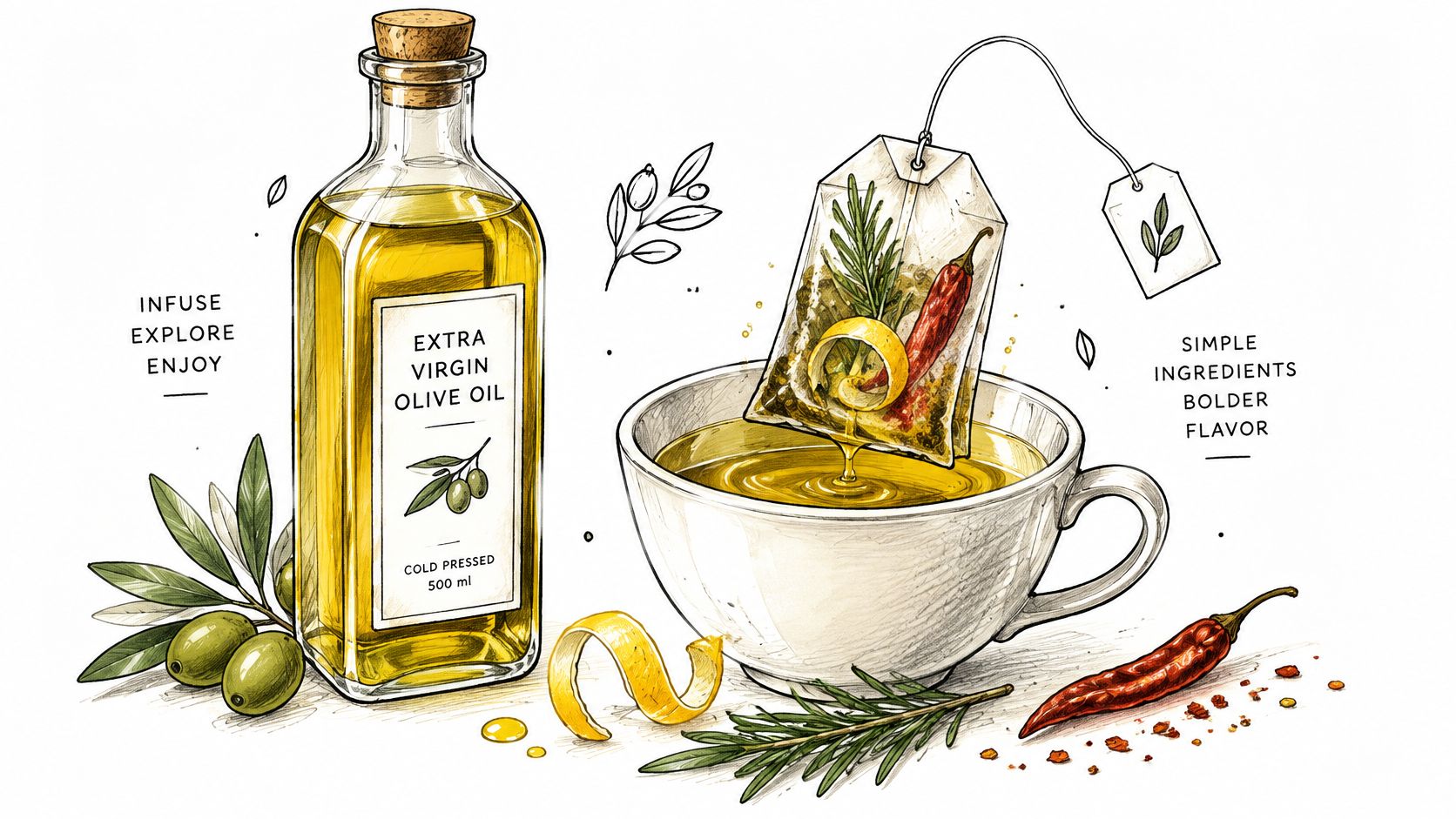
Four Flavor Sources You'll Meet on Labels
You'll see four main sources of that flavor. Whole ingredients like lemon peel, herbs, or chilies may be crushed or steeped with the oil. A finished oil may be infused after pressing. A maker may blend in a concentrated natural extract. Or the taste may come from essential oils or synthetic flavorings added in small amounts.
That distinction matters because flavored describes the added taste, not the grade of the oil underneath. You have to judge the base oil and the flavoring separately, just as you'd judge tea leaves and water separately.
The idea is old. Scented olive oil appears in the ancient Mediterranean and Near East, from myrrh and cinnamon oil used for priestly anointing in Hebrew scripture to aromatized oil offered to gods in ancient Greece. Today's shelf is newer, with lemon, herb, chili, truffle, and lavender versions made mainly for finishing dishes and dressings. It's also a real category, since PMR Market Research estimated the global infused olive oil market at USD 520.0 million in 2025.
Flavor Profiles and the Dishes They Suit
Start with one principle. A strong botanical can cover up the olive oil underneath, so you've got to match the oil's intensity to the food's intensity. A delicate piece of fish can't stand up to rosemary, and a pot of white beans will swallow a whisper of lemon.
That's not just a feeling. In research on basil and rosemary oils, a six-month study of virgin olive oil flavored with basil or rosemary quantified 27 aroma-related volatile compounds. Basil oil was shaped mainly by β-pinene, ocimene, and 1,8-cineole, while rosemary oil showed camphene, β-myrcene, α-terpinolene, limonene, and 1,8-cineole. Those compounds changed the oil's original profile and could mask some of the base oil's sensory cues, making defects or subtle green fruit notes harder to detect.
In plain terms, the flavoring can become the whole story. The cultivar and freshness of the base oil still matter, but your tongue will mostly notice the herb. Treat flavored olive oil as a sensory specification, not as proof of higher quality.
Matching Flavor Families to Food
| Flavor family | Typical examples | Intensity | Best matched dishes |
|---|---|---|---|
| Citrus | Lemon, orange, blood orange | Light | Fish, shellfish, green salads, grilled vegetables |
| Fresh herb | Basil, thyme, parsley | Light to medium | Tomatoes, mozzarella, white beans, bread |
| Rosemary | Rosemary, sometimes with thyme | Medium to strong | Roast potatoes, lamb, marinades |
| Chili | Chili, sometimes with garlic | Medium to strong | Beans, eggs, pizza, grilled meat |
| Truffle | Summer truffle with added flavoring | Strong, use in drops | Risotto, pasta, eggs, mashed potatoes |
| Lavender and floral | Lavender-infused olive oil | Light to medium, herbal | Lamb, goat cheese, roasted carrots, stone fruit |
Use the table as a starting point, then test before you commit. Put a drop on plain bread and taste it on its own. If it fills your mouth on bread, it'll fill the whole plate.
Practical rule: If you can't taste the food through the oil on a piece of bread, use less or pick a lighter flavor.
Dosage follows intensity. Truffle oil belongs in a few drops over a plate, not spoonfuls. Lavender oil works at a teaspoon at a time over lamb or chèvre, where you want fragrance rather than volume. Citrus and fresh herb oils are more forgiving, which is why they're a sensible first bottle.
Delicate citrus or herb oils suit finishing fish, vegetables, and vinaigrettes. More assertive rosemary, chili, or garlic profiles suit beans, roast vegetables, marinades, and bread dipping. If you're curious about less obvious pairings, this look at chocolate and olive oil shows how far a finishing oil can stretch beyond salad.
How Manufacturers Add Flavor to Olive Oil
Makers add flavor in four routes, from most hands-on to most processed. Each route trades taste, shelf life, cost, and consistency differently.
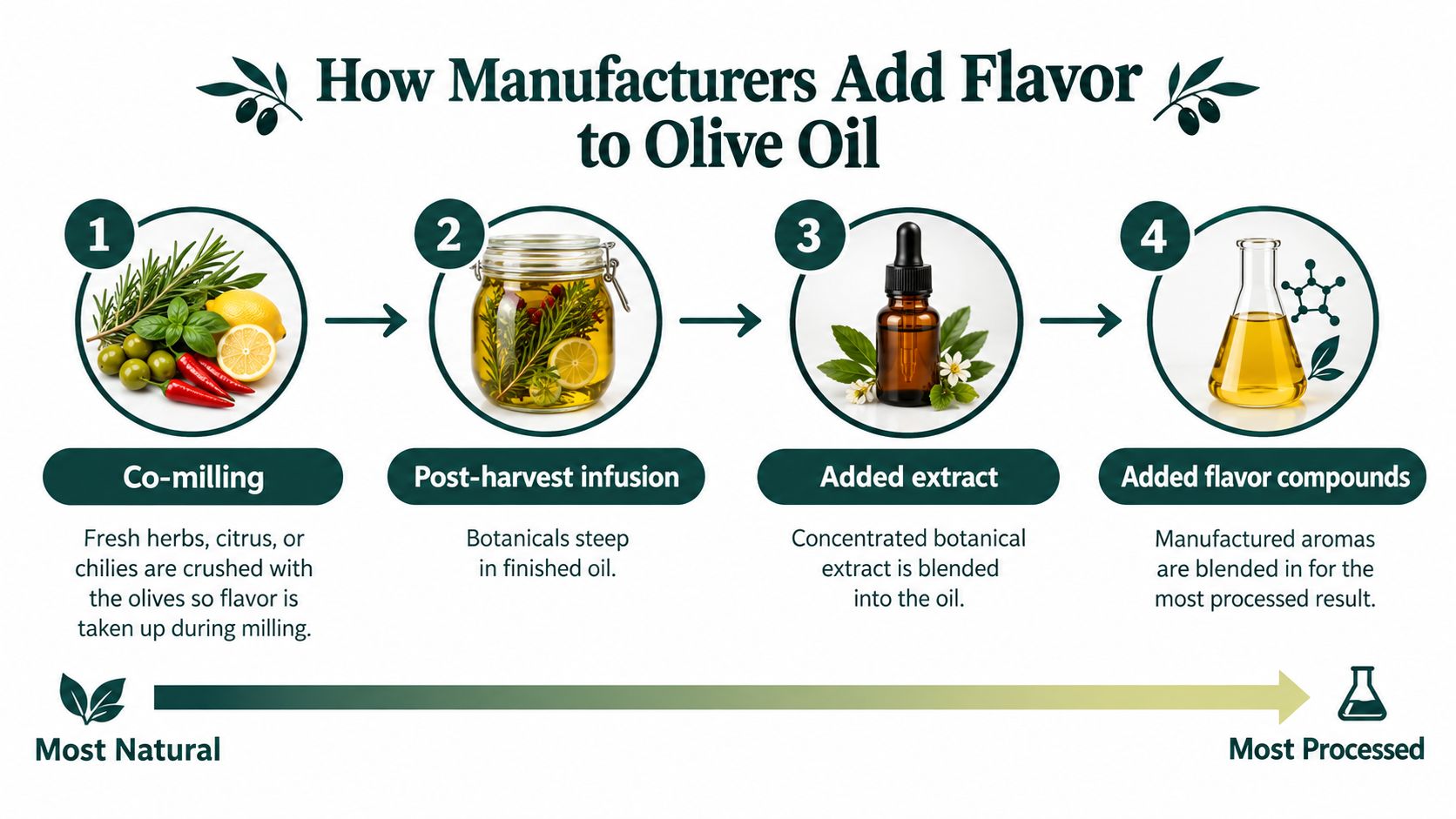
The Four Routes in Order
- Co-milling: Fresh herbs, citrus, or chilies are crushed with the olives, so the oil takes up flavor during milling before it's separated. The taste is closest to the raw ingredient, but batches vary.
- Post-harvest infusion: Finished extra virgin oil steeps with the ingredient for a set period, then it's filtered. Flavor is easier to control, but fresh material brings water into the oil.
- Added natural extract: A concentrated flavor is blended into the oil. You get the same taste from batch to batch, with less of the raw ingredient's nuance.
- Essential oil or synthetic flavoring: Small amounts of concentrated aroma compounds are added. This is the most consistent route and the least like the fresh ingredient.
Think of stock. Co-milling is like simmering a pot with bones and vegetables from scratch, while an extract is like a good concentrate you stir in. Neither is automatically wrong, but they don't taste the same and they don't cost the same.
| Route | Taste fidelity | Shelf stability | Cost | Consistency |
|---|---|---|---|---|
| Co-milling with fresh herbs, citrus, or chilies | High, closest to the raw ingredient | Moderate, depends on processing | High, slow to produce | Variable from batch to batch |
| Post-harvest infusion of extra virgin oil | High to medium | Lower when fresh material is used | Moderate | Moderate and controllable |
| Added natural extract | Medium, concentrated | High | Moderate | High |
| Essential oil or synthetic flavoring | Low, aroma only | High | Low | Highest |
The method also affects storage, because fresh material and added water change the safety picture. Truffle oils show this clearly, as this guide to olive oil with white truffle oil explains for that specific flavor.
Using Flavored Olive Oil in Cooking and at the Table
Here's the rule that saves you money. Heat drives off the volatile aroma compounds that give flavored olive oil its taste, so most of these oils are finishers, not cooking fats. If you fry with a lemon or truffle oil, you're paying for a flavor that fades before the food reaches the table.
When to Add It
| Use | When to add it | Heat guidance |
|---|---|---|
| Finishing pasta, risotto or eggs | Just before serving | Add raw, never cook it in |
| Salad dressing or vinaigrette | Whisk in at the end | Not heated at all |
| Dipping bread or crostini | At the table | Raw |
| Soup, beans or grilled fish | Off the heat, after cooking | Low; add at the end |
| Sautéing vegetables | Lower the heat first, add at the end | Moderate; aroma fades |
| Roasting vegetables or meat | Toss before or drizzle after | Moderate; partial aroma loss |
| Frying or high-heat searing | Avoid for the flavored oil | High; use a neutral oil instead |
A simple test helps. If the dish will keep cooking after the oil goes in, save the flavored oil for a dressing at the end. For frying or a hard sear, cook in a neutral oil and add your flavored olive oil at the table, the same logic covered in this guide to olive oil spray and how to use it.
Dosage keeps you honest. Il Boschetto Truffle Infused Extra Virgin Olive Oil is an Italian extra virgin olive oil with summer truffle infusion and flavoring, and it works in drops over pasta, risotto, or eggs just before serving. Stop earlier than you think you should. A lavender oil is similar, at a teaspoon over lamb, goat cheese, or roasted carrots, added at the end.
Cook the eggs first, plate them, then add the oil. The aroma you smell at the table is the whole point.
Try that order once and it sticks. Scrambled eggs first, then mushroom pappardelle another night, with the oil added after plating both times. You'll taste what you paid for.
Storage, Shelf Life and When Homemade Oil Is Unsafe
A pretty bottle of homemade garlic oil can be dangerous, and this needs saying plainly. A documented botulism outbreak involved chopped garlic mixed with extra virgin olive oil and stored at room temperature for approximately three months, as noted in University of California guidance on flavored oils. The bottle looked like any pantry gift. It wasn't safe.
Why Fresh Ingredients in Oil Are Risky
Fresh garlic, herbs, peppers, and citrus peel carry water. When they're submerged in oil, they sit in a low-oxygen, low-acid environment that can support Clostridium botulinum growth and toxin formation. You can't see or smell that toxin, so appearance tells you nothing.
Writing keep refrigerated on a homemade bottle doesn't fix long room temperature storage. Without validated acidification or another controlled process, refrigeration alone isn't a reliable basis for keeping a fresh ingredient oil on the counter. Shelf-stable commercial oils are different because processors use validated controls.
There's a tested method, and it's specific. University guidance for garlic, rosemary, oregano, and basil preparations requires the plant material to be soaked for at least 24 hours in a 3% citric-acid solution, kept fully submerged, before oil is added. Vinegar can't be substituted, because the validated procedure uses citric acid.
Storage by Oil Type
| Oil type | Storage | Shelf life | Risk level |
|---|---|---|---|
| Commercial shelf-stable flavored oil, unopened | Cool, dark cupboard | Until the best-before date | Low |
| Commercial shelf-stable flavored oil, opened | Cool, dark, tightly capped | Use within a few months | Low |
| Commercial refrigerated flavored oil | Refrigerate as the label directs | As printed on the label | Low when the label is followed |
| Homemade oil with dried herbs or dried chilies | Cool, dark; refrigerate if unsure | Use promptly and cautiously | Moderate |
| Homemade oil with fresh garlic, fresh herbs or fresh citrus peel | Do not keep at room temperature | No validated room-temperature shelf life | High |
So check any homemade bottle before you use it. If fresh garlic, herbs, or citrus peel went in without validated acidification, treat it as a refrigerated product to use promptly or discard it. Don't give it as a pantry gift, and don't accept one as a shelf decoration you plan to eat months later. For plain oils, this page on whether olive oil expires covers the separate question of freshness.
Reading a Label to Judge Quality
The most common confusion is this one. Extra virgin describes the olive oil component, and it doesn't automatically validate the finished flavored product as a single-ingredient oil. A bottle can start with good oil and still be vague about what flavored it.
Regulators treat that distinction seriously. UK government guidance on olive oil regulations says an olive oil infused with another substance must not be presented as pure olive oil, and the added flavoring must appear in the product description and ingredient list. Australian best-practice guidance adds that there are no established quality standards specifically for flavored oils, and recommends separating the flavor description from the oil grade while listing the flavoring agent and its percentage.
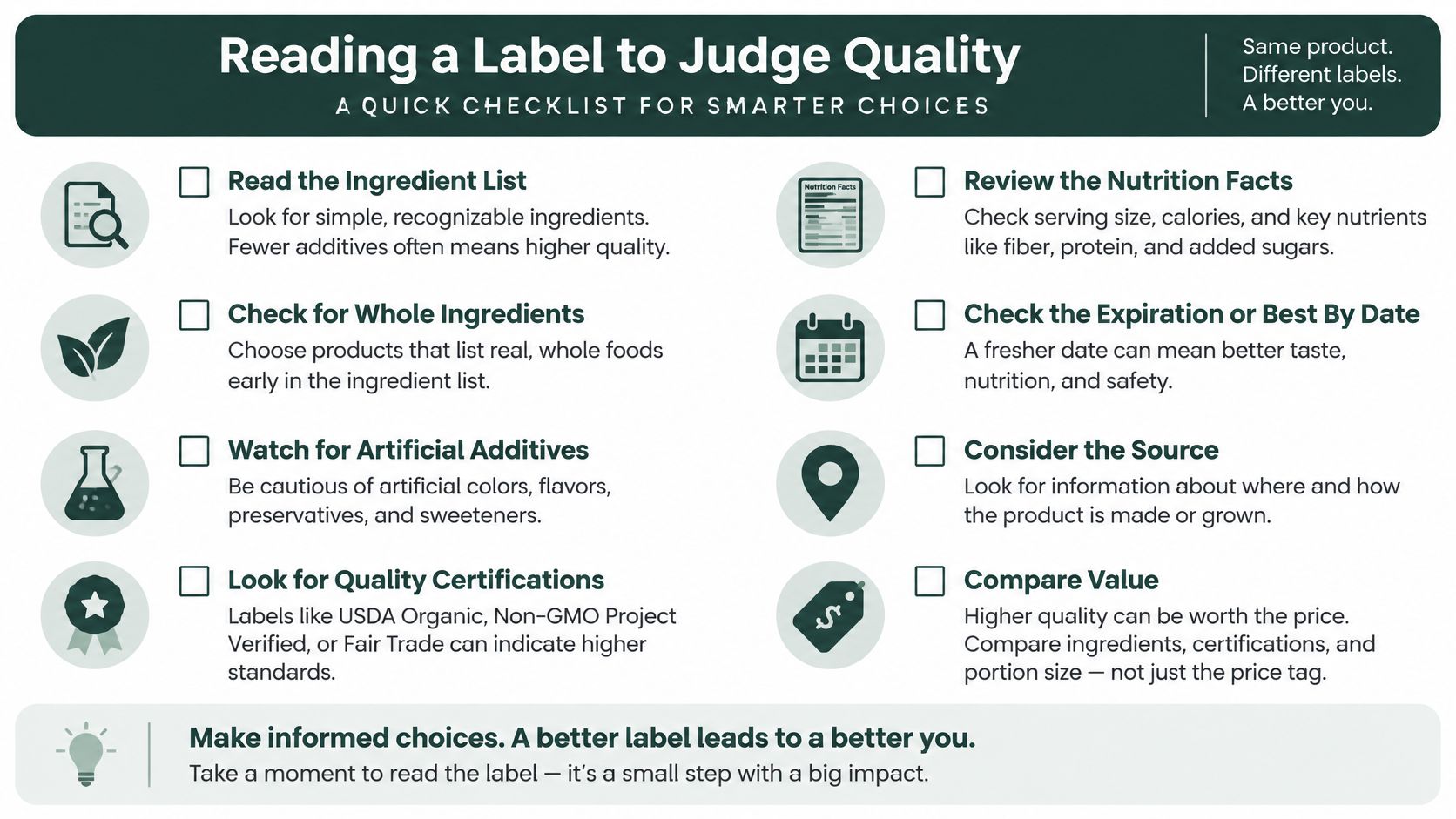
A Label Checklist With Reasons
- Base oil grade named separately: The grade tells you what oil you're paying for, apart from the flavor name.
- Flavoring agent with percentage: A truffle oil listing 2% summer truffle and 1% flavoring lets you judge what's carrying the aroma.
- Flavoring method stated: Co-milled, infused, extract, and synthetic flavoring imply different taste, traceability, and price.
- Harvest or best-before date: Freshness matters because aroma fades, and a date lets you plan use.
- Producer, region, and origin: Named provenance gives you someone accountable for the bottle.
- Storage instructions: The label should tell you whether the bottle belongs in a cupboard or the fridge.
If several of those are missing, you're buying on faith. The base oil questions overlap with plain oil shopping, so this guide to choosing extra virgin olive oil helps on that half of the label.
A rustic bottle with herbs floating in it tells you nothing about quality. The label is the evidence.
Choosing Your First Bottle by Use
If you're a home cook, buy one versatile citrus or herb oil first. Use it on fish, salads, and vegetables for a few weeks before buying a second, because one bottle teaches you how intensity behaves on your own food.
If you're hosting an aperitivo or brunch, pick two contrasting oils, such as a citrus and a chili, and set them beside bread, cheese, and white beans so guests can compare. If you're buying a gift, match the flavor to the recipient's habits, and remember that strong truffle or lavender oils are used in drops or teaspoons, so a small bottle lasts.
Ordering for several recipients or repeat use calls for comparing case or bulk sizes. On a tight budget, compare price per 100 ml rather than bottle size or a decorative label. The short video below shows a simple finishing use at the table.
Before checkout, confirm the base oil grade and flavoring method, check the best-before date, decide where you'll store it, and buy the smallest size for a first try. Read the storage guidance above again before buying any homemade or unlabeled bottle.
Visit Lello.Store to browse a small, edited range of extra virgin and infused olive oils from named makers, each listed with ingredients and use guidance. Start with one versatile bottle for fish and salads, add a stronger finishing oil when you're ready, and use the store's guides and gift tools if you're choosing for someone else.