

The familiar advice is to buy an artisanal sea salt and expect better flavor. That skips the questions that matter: where was it produced, what does its certification guarantee, and will its crystals dissolve into dinner or remain noticeable on top? Sicily sea salt is worth understanding as an ingredient, not just collecting as a souvenir.
Table of Contents
- Why Sicily Sea Salt Deserves a Closer Look
- The Salt Pans of Trapani and the Stagnone
- How Trapani Sea Salt Is Made
- What Sicilian Sea Salt Is and Is Not
- A Working Comparison of Sicily's Salt Formats
- Putting Each Salt to Work in the Kitchen
- Finishing Salt vs Cooking Salt and Why the Swap Fails
- Buying, Storing, and Using Sicily Sea Salt With Confidence
Why Sicily Sea Salt Deserves a Closer Look
“All sea salt is interchangeable” is an unhelpful shortcut. So is the opposite claim that a Sicilian origin automatically makes salt taste better. A cook needs to separate verifiable production standards from a preference for a particular texture.
The strongest starting point is Sale Marino di Trapani IGP, the protected geographical indication associated with production in Trapani, Paceco, and Marsala. Its written specification addresses origin, composition, moisture, insoluble residue, and limits for specified contaminants. Those are concrete requirements, unlike an attractive label that says only Mediterranean or artisanal. The Sale Marino di Trapani IGP specification also sets an iodine minimum of 0.70 mg/kg, which shouldn't be confused with a claim about iodine fortification.
What certification can tell you
Certification gives you a defined production framework. It doesn't tell you that every certified packet has the same grain size, that every crystal will suit your grinder, or that you'll prefer it on a tomato.
For shopping purposes, keep these questions separate:
- Origin: Does the package identify the protected designation, or merely describe the salt as Sicilian?
- Format: Is the salt fine, coarse, or intended for finishing?
- Processing: Does the label explain additives, drying, or other handling relevant to your use?
A regional name answers a different question from a culinary format. The same distinction matters when comparing Sicilian salt with a finishing product from elsewhere, as the editorial account of why Lello chose Sal de Ibiza fleur de sel helps illustrate.
Buying principle: Treat provenance as something to verify and texture as something to match to the food.
You don't need to dismiss the story behind the salt. You shouldn't ask that story to substitute for an ingredient label.
The Salt Pans of Trapani and the Stagnone
Shallow coastal water, steady sunshine, and a drying wind will make salt anywhere they meet. Western Sicily happens to combine all three with a shoreline flat enough to enclose into evaporation ponds, which is why the surviving production areas cluster at Nubia near Trapani and across the Stagnone lagoon north of Marsala.
Seeing the ponds' relationship to the coast explains more than any description can.
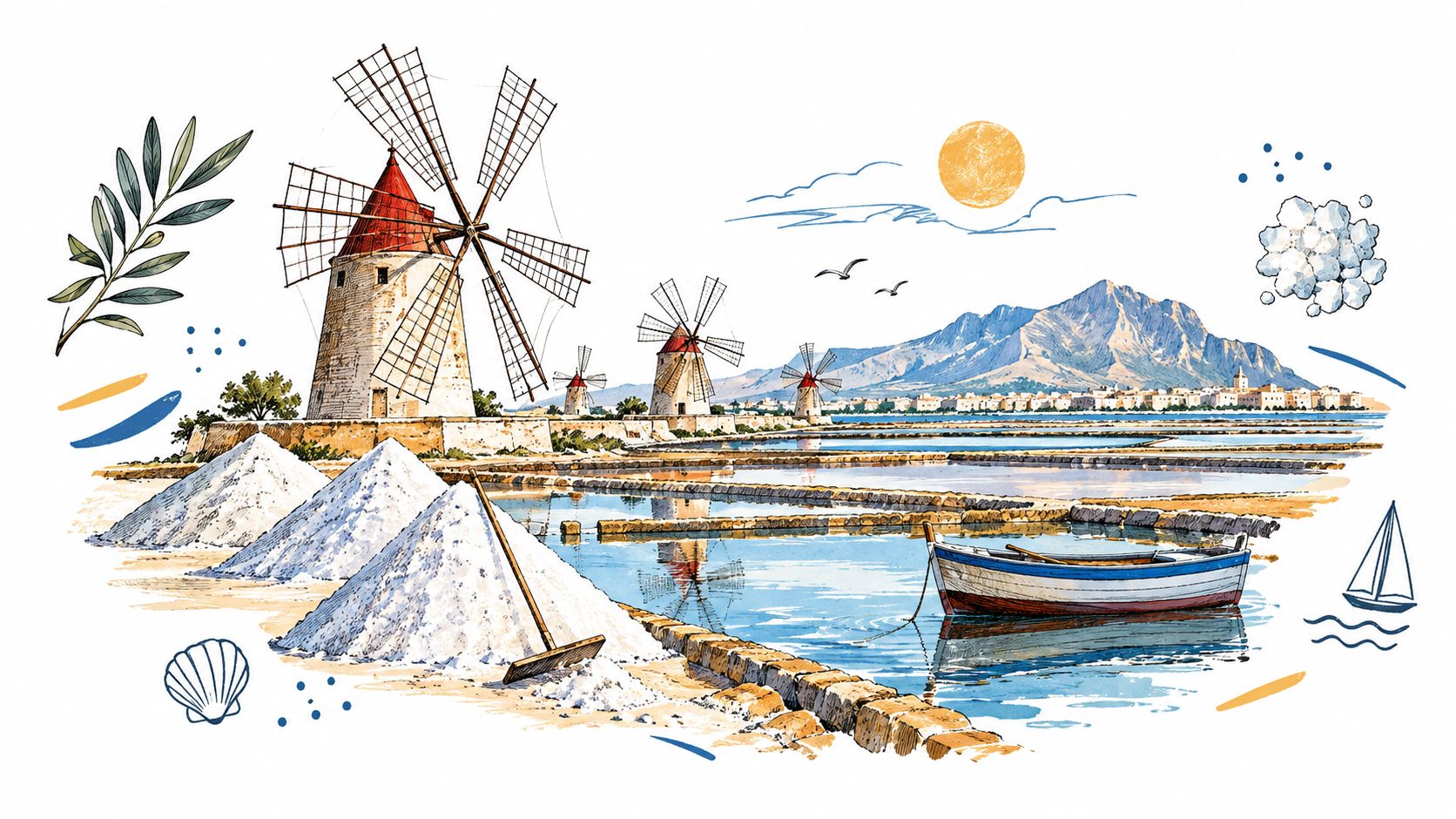
The written record reaches further back than the scenery suggests. A history of Sicily's salt pans traces activity along the Trapani and Marsala coast through three distinct periods:
| Period | What the record shows |
|---|---|
| Around 900 BCE | Salt working associated with Phoenician activity along this coast |
| 1154 | The Arab geographer al-Idrisi describes an extensive salt pan between Trapani and Mount Erice |
| 16th to 18th centuries | Production expands substantially to supply Mediterranean trade |
That sequence describes organized industry. Producers were directing seawater into managed ponds and letting evaporation do the concentrating, a coastal operation built around terrain that lent itself to control.
The video shows the working version of that setting.
One distinction is worth keeping straight while you watch. The age of the pans tells you the geography works, generation after generation, with sun and wind performing the same concentration they have always performed here. A named production area like Trapani or the Stagnone gives a label something concrete to point to, and that specificity is what separates a verifiable origin from a broad Mediterranean description.
How Trapani Sea Salt Is Made
Trapani sea salt isn't made by filling a pond and waiting for everything in the seawater to become seasoning. Producers use fractional precipitation, moving seawater through successive ponds as its salinity increases.
Different dissolved substances reach the point of precipitation under different conditions. The pond sequence lets less-soluble material separate out before sodium chloride crystallizes in the final ponds. That separation is what distinguishes controlled concentration from indiscriminate drying.
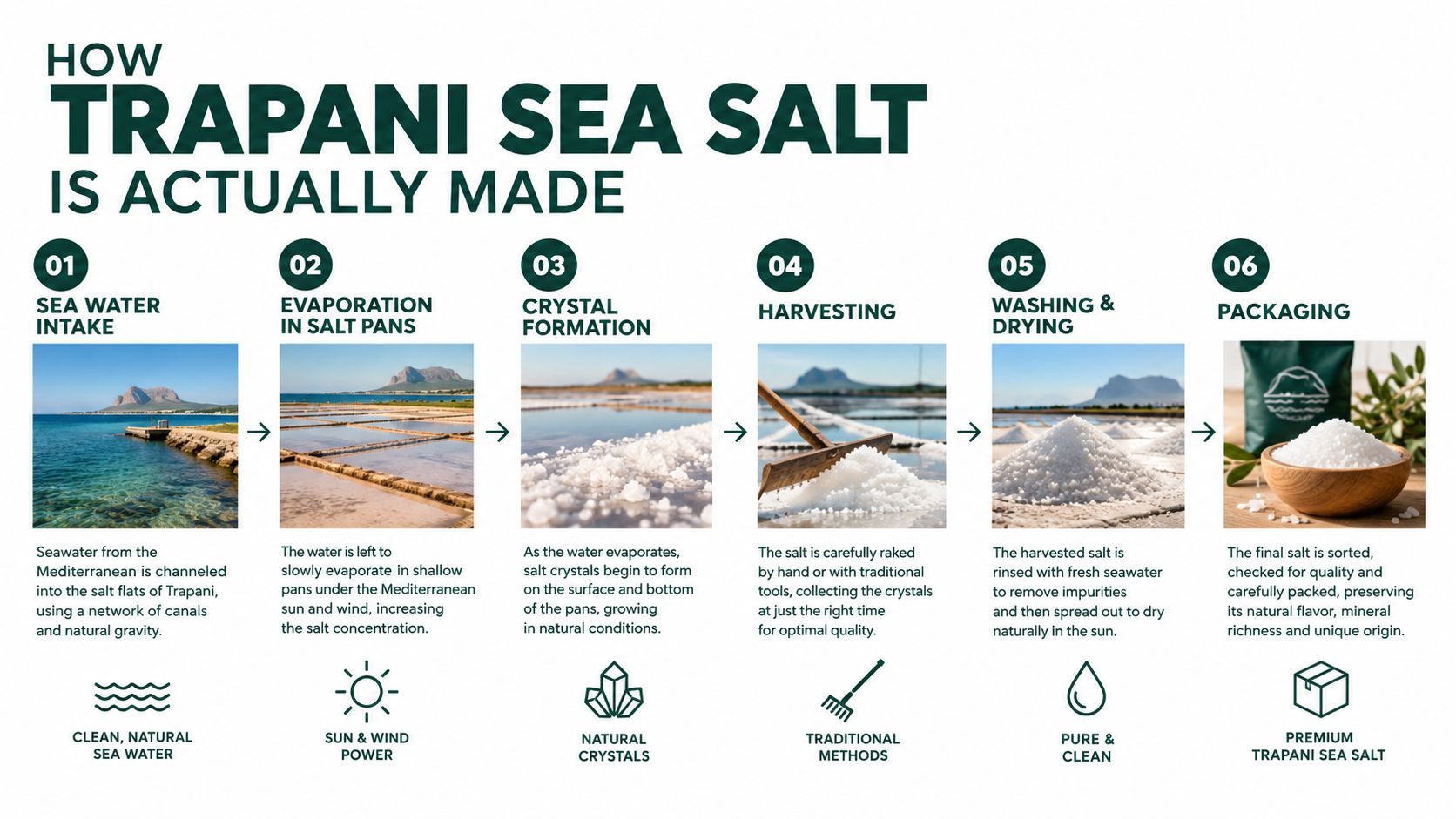
The Trapani solar season generally runs from May through September, with crystallization following approximately five months of sun-and-wind-driven concentration. Standards described in Saline Culcasi's account of Trapani sea salt production require more than 97% sodium chloride on a dry-matter basis and less than 8% residual moisture, alongside limits for minerals and trace contaminants.
Within that season, each stage is a separate decision:
- Concentrate the water. Producers manage movement and residence time as evaporation raises salinity.
- Separate before crystallization. Pond sequencing keeps earlier precipitates apart from the final salt crop.
- Drain and store. Handling after crystallization reduces retained mother liquor, the concentrated liquid left around the crystals.
The dry-matter qualification deserves a second look. It describes composition after accounting for water, while the moisture requirement addresses water separately. Neither figure tells you the exact moisture content of every packet on a shop shelf.
Natural production doesn't have to mean unstandardized production.
For a home cook, this removes a false choice. You can value solar evaporation without assuming the resulting salt is chemically uncontrolled. The specification establishes a production baseline; grain size and handling instructions still decide whether a given packet suits a grinder or a baking recipe.
What Sicilian Sea Salt Is and Is Not
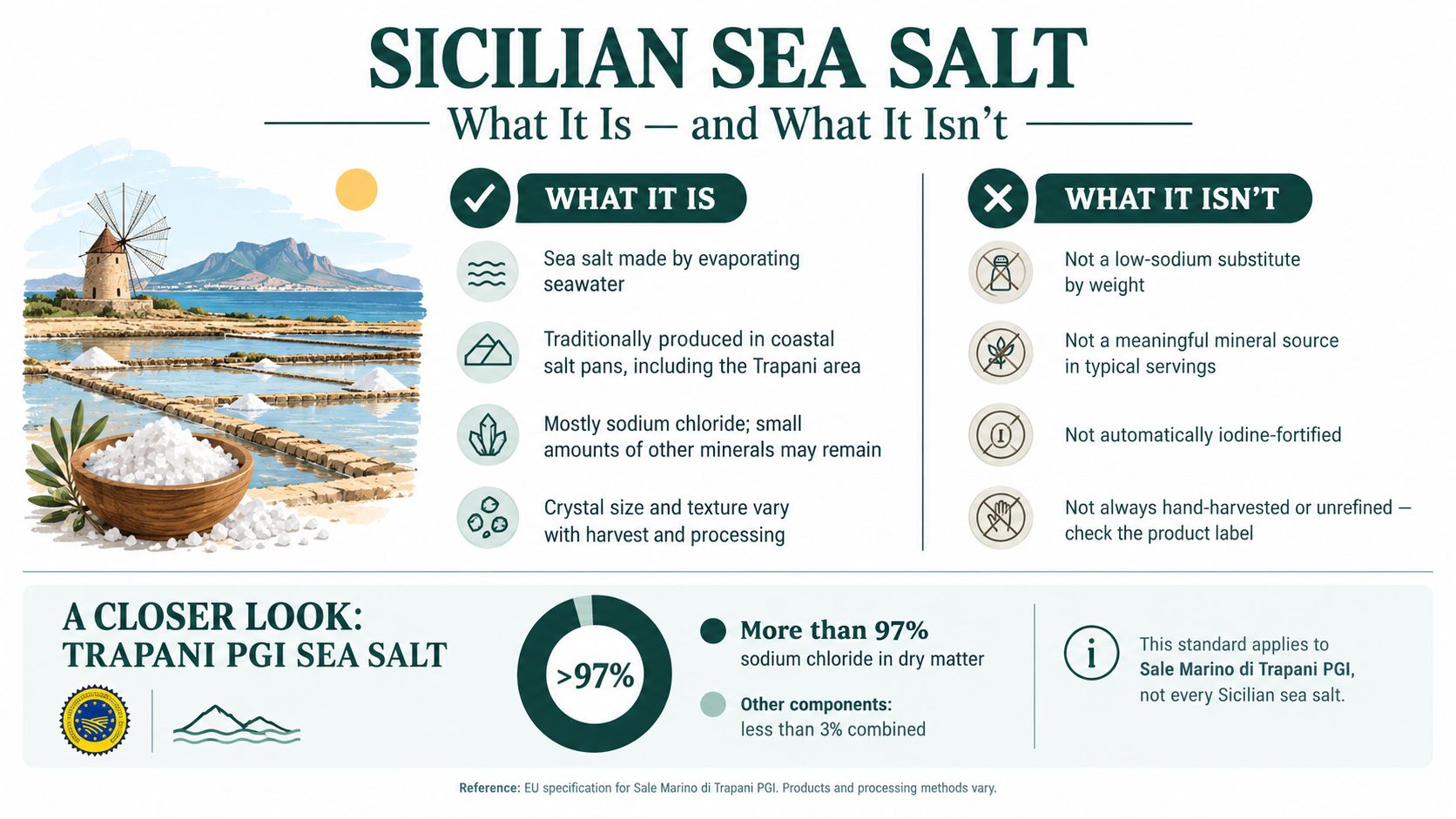
Sicilian sea salt is a seasoning ingredient. Calling it a mineral supplement overstates what the chemistry shows, since trace elements carried in the residual moisture do not add up to a meaningful dietary contribution.
A laboratory analysis reports approximately 0.05 g/kg magnesium, 0.07 g/kg potassium, 0.094 g/kg calcium, and 6 mg/kg iron in Trapani salt, with copper, zinc, manganese, and phosphorus at or below very low analytical limits, according to the published Trapani salt composition study. One figure in that study deserves caution before it is repeated: a sodium-chloride value given as 99.6 g/kg sits oddly beside a product described as nearly pure sodium chloride, so the number should not circulate as a purity percentage until the reporting basis is resolved.
What determines the eating experience
Three physical variables decide what this salt does in food: crystal shape, moisture, and dissolution rate. A coarse crystal survives the trip from pan to plate and dissolves on the tongue in concentrated pockets. A fine grain disperses evenly through a sauce the moment it is stirred in. Same sodium chloride, different delivery.
That contrast is mechanical, and it explains why two salts of identical purity can season the same dish differently. A crystal still intact on a slice of tomato produces a burst of saltiness that the same quantity dissolved into pan juices never will.
The nutritional and sensory questions answer different problems. Measured mineral residues sit far below what ordinary foods supply, so they give no reason to reach for more salt. Iodine is a labeling matter rather than a given, since natural sea salt is not iodized unless the package says so. Check the specific product for fortification instead of assuming.
The defensible case for buying it runs on provenance and format. Expect it to season food well and to carry a documented origin. Do not expect it to do the nutritional work of foods rich in magnesium or potassium, and read "natural" as a description of process rather than a health claim.
A Working Comparison of Sicily's Salt Formats
A pantry comparison should distinguish origin, grain, and purpose. Fine sea salt isn't necessarily Sicilian, fleur de sel isn't a synonym for every coarse crystal, and a herb-seasoned blend adds ingredients that plain salt doesn't contain.
The table below is a buying aid, not a ranking. Where moisture isn't documented for a particular product, an unknown is more honest than an invented description.
Comparing Sicily and Mediterranean Salt Formats
| Format | Origin | Crystal size | Residual moisture | Best kitchen role | Authenticity marker |
|---|---|---|---|---|---|
| Coarse Trapani sea salt | Western Sicily | Coarse, check the grade | Check product details within the applicable specification | Dissolved seasoning or deliberate coarse finishing | Explicit Sale Marino di Trapani IGP designation when certified |
| Fine Mediterranean sea salt | Producer-dependent Mediterranean origin | Fine | Product-dependent | Baking, doughs, sauces, and brines | Named producer, origin, and ingredient statement |
| Delicate finishing salt or fleur de sel | Named salt-producing region | Check the actual crystal structure | Check the product description | Final seasoning where texture remains noticeable | Specific provenance and a clearly described finishing format |
| Herb-seasoned coarse salt | France for the blend discussed below | Coarse with herbs | Product-specific, not established here | Meat and vegetables before cooking | Ingredient list and stated blending origin |
Coarse Trapani salt is the provenance-led option here. Its trade-off is that you must decide whether its undissolved texture is useful or whether it should disappear into liquid.
Fine sea salt prioritizes distribution. A regional story matters less than predictable handling when you're working a weighed quantity through dough.
Finishing salt earns consideration when the crystal itself remains part of the bite. The broader comparison of fleur de sel, sea salt, and kosher salt helps separate those roles.
For a seasoned alternative, The Butcher Salt combines French coarse sea salt with rosemary, thyme, sage, and marjoram. Choose it when you want those herbs, not as a neutral substitute.
The Lello Etched Kosher Salt Vessel is a separate everyday-cooking option: included kosher salt in refillable dark violet glass with permanent etching. It isn't presented as Sicilian salt or a finishing salt.
Putting Each Salt to Work in the Kitchen
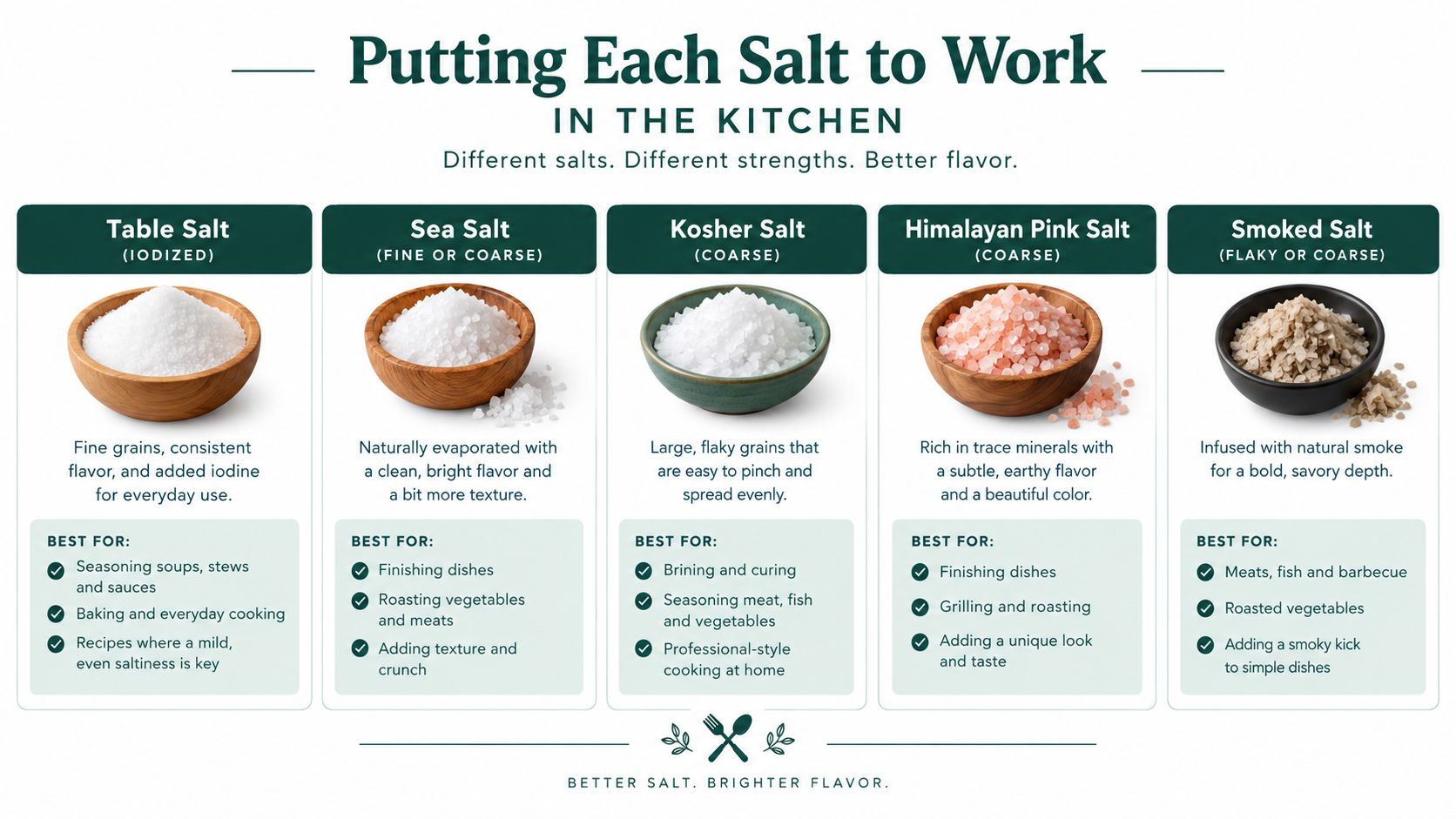
Start with the result you want on the plate. A dissolved seasoning, a noticeable crystal, and an herb coating are different jobs, even when each begins with a pinch of salt.
When the salt should disappear
For pasta water, coarse Trapani salt is a workable choice if you allow it to dissolve and stir before judging the seasoning. Its original crunch isn't something you're preserving in the finished pasta. Consider the whole dish, including the sauce, rather than treating the water as an isolated seasoning decision; the guide to why we salt pasta water and when to use less develops that practical distinction.
For doughs, baking, and brines, choose a consistent fine or medium grade and weigh it when precision matters. A teaspoon isn't a fixed mass across salts because grain size, packing, and humidity affect how much it holds. Use a tested recipe for preservation projects rather than improvising a brine from taste.
When the crystal should remain
A tomato salad or sliced seared steak offers an opportunity to test coarse salt as a finishing ingredient. Apply a little to a portion first, then decide whether the texture is pleasing or too assertive.
Use these applications as small kitchen experiments:
- Bread and mozzarella: Try a delicate finishing crystal where you can notice it without competing with a complicated sauce.
- Caramel: Add a restrained final sprinkle when you want distinct salty accents rather than uniform seasoning.
- Roasted vegetables: Use a herb-seasoned blend before cooking when the herbs belong in the dish.
- Raw proteins: Follow the blend's directions and account for its salt before adding other salty ingredients.
At the stove: Taste the food after the salt has had time to behave as intended.
That last step matters more than buying a prestigious origin. Adjusting too soon can leave you compensating for crystals that haven't yet dissolved, rather than for the seasoning the dish will have.
Finishing Salt vs Cooking Salt and Why the Swap Fails
Drop an expensive finishing salt into a long-cooked bolognese and you give up the feature you selected it for. Once it dissolves, the visible crystal and its texture are gone. That isn't a cooking disaster, but it may be an unnecessary use of a format you wanted to experience at the table.
The reverse substitution can be more noticeable. An oversized cooking crystal on a just-fried egg may make one bite unpleasantly salty while leaving the next barely seasoned. That doesn't mean coarse salt never belongs on finished food. It means the grain must suit the surface and the portion.
Separate inconvenience from failure
Some swaps fail because of distribution, not because the salt has the wrong birthplace. Others work perfectly well but offer no particular benefit.
- In a wet sauce: Fully dissolved salt has no remaining crunch to distinguish a finishing format.
- On a delicate surface: A large crystal can be more assertive than you intended.
- In pasta water: Finishing salt can season it. The practical concerns are dissolution, dose, and whether you're using the format sensibly.
There's no sound reason to claim that finishing salt automatically under-seasons pasta water or that coarse Trapani salt must taste metallic. Those outcomes don't follow from the category name.
Keep cooking salt for predictable seasoning and finishing salt for a deliberate final texture.
The useful case for separate jars is control, not ceremony. You can reach for one while building a dish and another when evaluating the final bite. The guide to what fleur de sel is and how to use it offers a practical reference for that finishing role.
You don't need an extensive collection. A reliable everyday salt and a finishing texture you enjoy can cover the distinction without turning routine seasoning into a tasting ritual.
Buying, Storing, and Using Sicily Sea Salt With Confidence
At the shelf, make a decision in a sensible order: establish what the product is, then decide whether you have a use for it. A beautiful salt-pan photograph isn't evidence of certification, and a protected name isn't a promise that the grain fits every recipe.
If you're buying certified Trapani salt, look for the actual designation rather than inferring it from a Sicilian address or a seller's description. For an uncertified product, ask for straightforward information about its producer, origin, ingredients, and format.
Buying rules worth keeping
- Verify before romanticizing: Favor a clear product identity over broad adjectives such as pure, traditional, or mineral-rich.
- Assign the salt a job: Know whether you're buying a staple to dissolve, a texture to finish with, or a seasoned blend for cooking.
You can put those rules into practice before opening the packet. Read the label, inspect any visible grain, and compare the handling information with what you cook. If the seller doesn't provide enough detail, ask rather than filling the gaps with assumptions.
A storage habit that supports consistency
Keep the package or vessel closed between uses, and choose a spot away from the direct steam of a boiling pot. Use a dry spoon or dry fingers, and retain the original label if you decant the salt so that provenance and ingredient information don't disappear.
Glass can be a convenient storage option, but don't confuse the vessel's appearance with proof of the salt's origin or quality. For broader pantry organization, consult the guide to what belongs in the refrigerator rather than applying one storage rule to every specialty ingredient.
The confident purchase isn't necessarily the most elaborate one. It's the salt whose identity you can establish, whose format you understand, and whose place in your cooking is clear.
Lello.Store offers finishing salts, everyday cooking salt in a refillable vessel, and practical pantry guides that connect ingredients to their uses. Visit Lello.Store to choose a salt for the stove or the table, using documented origin and the texture you want as your starting points.