

The most familiar advice about finishing salt is to buy a celebrated regional name and sprinkle it on everything. That's an incomplete buying strategy. The best finishing salts are the ones whose crystals suit the food, whose aroma belongs on the plate, and whose quantity you can control. A prestigious origin won't rescue a hard crystal on a delicate egg or preserve a flake you dissolve into sauce.
Start with the effect you want: quick, even seasoning, a fragile crunch, or a deliberate smoky accent. Then compare the salt's form and the amount you end up applying. Origin adds useful context, but it isn't a substitute for testing what happens in a bite.
Table of Contents
- Five Finishing Salts Compared by Origin, Taste and Texture
- How Crystal Size Changes Seasoning Impact
- Matching a Finishing Salt to Each Dish
- How Much Finishing Salt Is Safe Each Day
- What to Check Before You Buy
- Choosing Your First Finishing Salt
Five Finishing Salts Compared by Origin, Taste and Texture
Five finishing salts at a glance
| Salt | Origin | Crystal form | Best use |
|---|---|---|---|
| Fleur de sel | Salt pans in France and Spain | Delicate, moist, hand-skimmed crystals | Eggs, vegetables, steak |
| Maldon sea salt flakes | Maldon, Essex, England | Hollow pyramid-shaped flakes | Roasts, salads, tomatoes, chocolate |
| Camargue fleur de sel | Camargue wetlands, southern France | Delicate surface crystals; inspect the producer's description for color | Butter, grilled fish, tomatoes |
| Sal de Ibiza | Ibiza salt flats, Spain | Delicate crystals; check the specific product's grade | Seafood, potatoes, vegetables |
| Smoked finishing salt | Producer-specific origin, commonly sea salt | Flakes or coarse crystals carrying smoke aroma | Grilled meat, potatoes, eggs |
These aren't equivalent categories. Fleur de sel describes a harvesting tradition, Maldon identifies a particular maker and place, Camargue identifies a region, and smoked salt describes an aromatic treatment. Comparing them as though they were interchangeable brands obscures the information a cook needs.
What each salt contributes
Fleur de sel is the delicate surface salt skimmed from evaporation ponds, including those in France and Spain. The name describes a harvest method rather than a brand, so don't expect every jar to have identical moisture, grain size, or texture. Its appeal is a restrained crystalline finish on soft foods, not necessarily the conspicuous crunch of a broad dry flake.
Try it on eggs, warm vegetables, or sliced steak when you want salinity to remain perceptible without introducing a large, hard grain. Describe its taste as clean or briny only as a sensory impression, not as proof that it contains less sodium or fewer contaminants. The useful buying question is whether the actual crystals feel appropriate for your food.
Maldon sea salt flakes, from Maldon in Essex, England, offer a different physical experience. Their hollow pyramid-shaped structure breaks readily, making them useful when you want visible flakes and a brittle crunch rather than the resistance of a dense coarse crystal. Leave them mostly intact on substantial tomato slices or roasts, and crush them lightly over chocolate or smaller bites.
A mild finish is a tasting description, not a nutritional advantage. If you enjoy the shape but find individual flakes distracting, change the size between your fingertips before changing the product. That adjustment lets you separate a problem of application from a problem of salt selection.
Camargue fleur de sel comes from the wetlands of southern France and belongs within the broader fleur de sel family. Its regional identity is useful context, but don't assume every Camargue jar will be grey or taste earthy. Grey salt harvested in contact with a pond's clay and delicate surface-harvested fleur de sel shouldn't be treated as the same specification.
For butter, grilled fish, and tomatoes, inspect the crystals and taste the particular jar. An earthy or mineral impression can be part of your tasting notes, but it shouldn't become a guaranteed regional flavor claim.
Origin tells you where the salt was made. Texture tells you how it behaves on food.
Sal de Ibiza brings Spanish provenance to the comparison, but the product name still matters. Don't assume every salt from Ibiza has the same thin, flaky form; identify whether you're buying fleur de sel or another grade. Our French Pantry includes Sal de Ibiza Fleur de Sel in a 4.4 oz ceramic jar, from Spain.
For seafood, potatoes, and vegetables, scatter it over a plated portion and assess whether the crystal size suits the bite. If Mediterranean provenance interests you, our guide to Sicily sea salt offers another regional reference without making geography a performance ranking.
Smoked finishing salt adds an extra variable: aroma. Its origin and crystal structure remain producer-specific, so inspect both the ingredient list and the grain description. Choose it when potatoes, eggs, or meat would benefit from a smoky note, rather than adding it automatically to food that already tastes strongly of smoke.
A useful side-by-side tasting
Place each salt on comparable slices from the same plain tomato. Taste for the first saline impression, the resistance of the crystal, and what remains after swallowing. Keep oil, herbs, and dressing out of this initial comparison so they don't mask differences.
Use equal weights when comparing seasoning intensity, then try your normal pinch to evaluate handling. Those are different tests: one compares the salt under controlled application, while the other reveals how your fingers portion it.
How Crystal Size Changes Seasoning Impact
Crystal size and where each salt performs best
| Crystal size or form | Dissolving behavior | Best application | Watch for |
|---|---|---|---|
| Fine, below the experimental size threshold | Rapid delivery and strong early saltiness | Buttered vegetables, eggs, popcorn | Easy to overapply |
| Medium or larger compact grains | Slower delivery than fine particles in the cited tests | Salads, roasted potatoes, grilled vegetables | Uneven distribution on dry surfaces |
| Thin flakes, size not reported | Shape can encourage rapid dissolution; intact flakes also provide intermittent crunch | Tomatoes, chocolate, cheese boards | Visible size doesn't establish sodium weight |
| Coarse dense crystals, size not reported | Generally persistent, localized crunch | Steak, crusty bread, selected baked goods | Hard grains can dominate small bites |
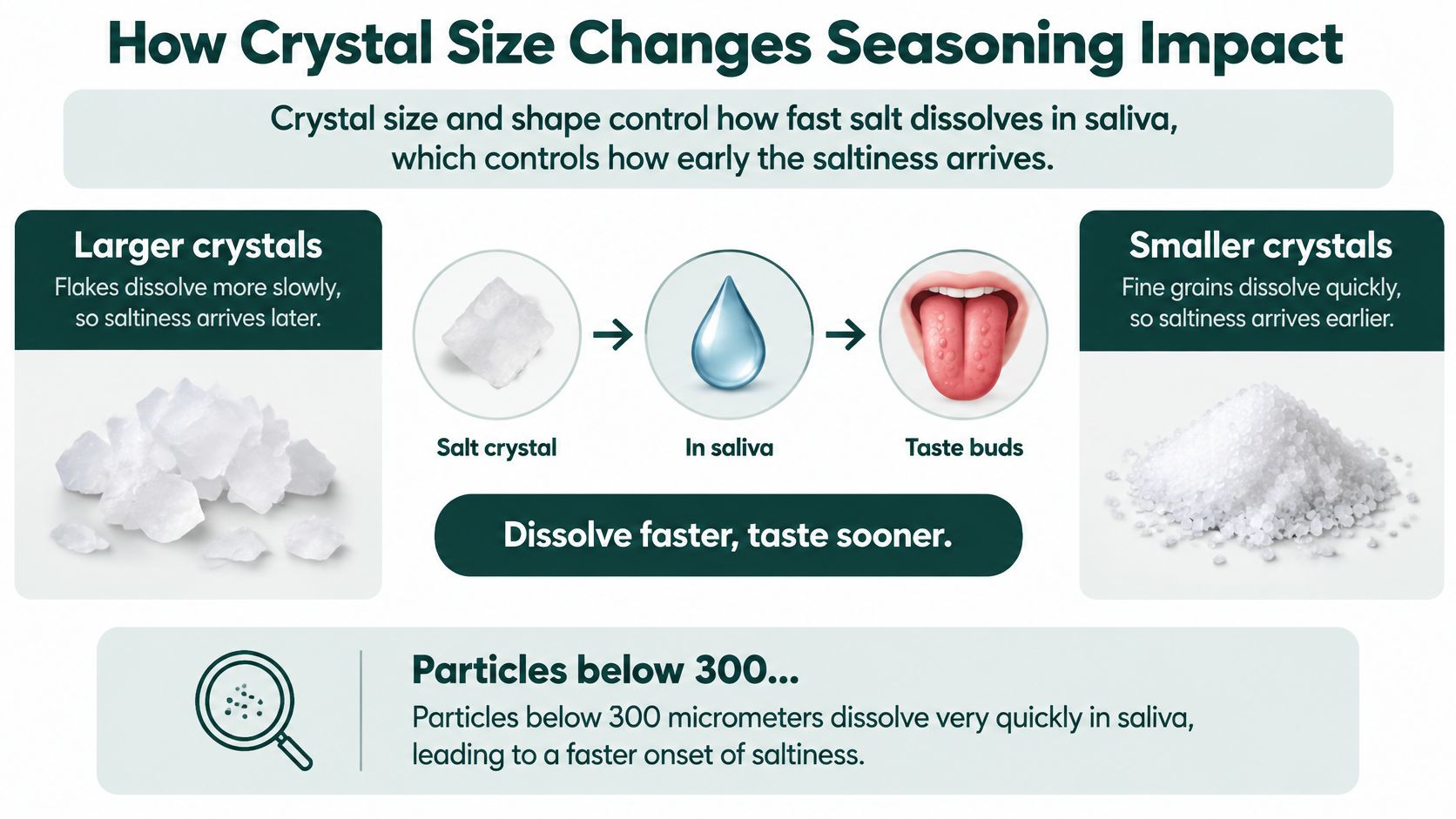
The food-science review on salt characteristics and perception reports that particles below 300 micrometers produced significantly greater saltiness than particles 400 micrometers or larger in experimental work on solid foods, with the 100 to 200 micrometer range producing the strongest response. These are experimental particle ranges, not a grading standard for every retail finishing salt.
Read size and shape together
Fine crystals are the practical choice when you want seasoning to arrive quickly and distribute across many small surfaces. Popcorn and buttered vegetables benefit from coverage rather than isolated large grains. The aim isn't to see the salt, but to place it where it will be tasted.
Medium compact grains suit food with enough surface moisture and substance to accommodate them. On roasted potatoes or grilled vegetables, check whether the grains adhere and soften instead of falling to the plate. A grain-size label alone can't predict that result.
Thin flakes complicate a simple small-to-large ranking. A broad, hollow flake can expose considerable surface area and fracture readily, so it shouldn't automatically be classified as slower-dissolving than a smaller compact cube. Choose flakes for the combination of fragile crunch and localized seasoning, not because their visible width proves potency.
Coarse dense crystals are a more deliberate textural choice. Test them cautiously on steak or bread, and crush them if the resistance distracts from the food. Our guide to what fleur de sel is and how to use it helps distinguish delicate finishing crystals from coarser alternatives.
Practical distinction: Identical weights can produce different perceived intensity.
Compare the food surface too
Moisture, surface fat, adhesion, and the position of a crystal all affect its delivery. Don't assume an oily surface behaves exactly like a watery one; oil can help salt stay attached without itself dissolving the crystal.
For a repeatable comparison, record grams applied per serving, crystal form, food surface, and application timing. Heat and moisture may remove the textural distinction, while leaving the sodium contribution in the food.
Matching a Finishing Salt to Each Dish
Salt's role depends on where and when it reaches the food. Seasoning salt is incorporated during cooking as the dish develops. Finishing salt is applied near the end, where it can shape the taste and texture of specific bites.
Fleur de sel is a delicate finishing salt added at the table. The Butcher Salt is a coarse herb seasoning used before and during cooking. Choose between them by the job the dish needs, not by origin alone.
Build the base during cooking
Use an everyday cooking salt for pasta water, soups, sauces, and foundational seasoning. The Lello Etched Kosher Salt Vessel is intended for everyday cooking salt used in pots and for base seasoning. It serves a different purpose from a final textural garnish.
Taste the completed dish with its sauce and accompaniments before adding a finishing salt. Capers, cheese, cured ingredients, and dressings may already contribute enough salt. A final pinch is optional, and should improve the balance rather than add another layer.
Pair the salt with the serving moment
- Eggs: Add fleur de sel after removing the pan from the heat, close to serving. Scatter it lightly over scrambled or fried eggs so the salt accents the dish without forming a continuous salty layer.
- Steak: Rest and slice the meat, then place coarse crystals or broken flakes on the cut surfaces. Taste a complete bite first, particularly if the meat was seasoned generously before cooking.
- Chocolate and caramel: Fragile flakes can contrast with a smooth, sweet background. On caramel, distinguish salt mixed into the confection from flakes added to its finished surface.
- Tomatoes: Add thin or Maldon-style flakes just before serving when a crisp finish is wanted. Distribute them across the slices rather than piling them in the center.
- Salads: Dress and toss the salad first, then add a light scatter. Taste a dressed bite before deciding whether extra salt improves the balance.
For an aromatic option, the white truffle salt guide offers a separate pairing reference. Treat aromatic salt as its own seasoning choice, rather than assuming it can replace plain flakes in every dish.
The working rule is to season the base deliberately, then finish only the bites that benefit from it. Keep finishing salt away from the pot until you have tasted the plated food.
How Much Finishing Salt Is Safe Each Day
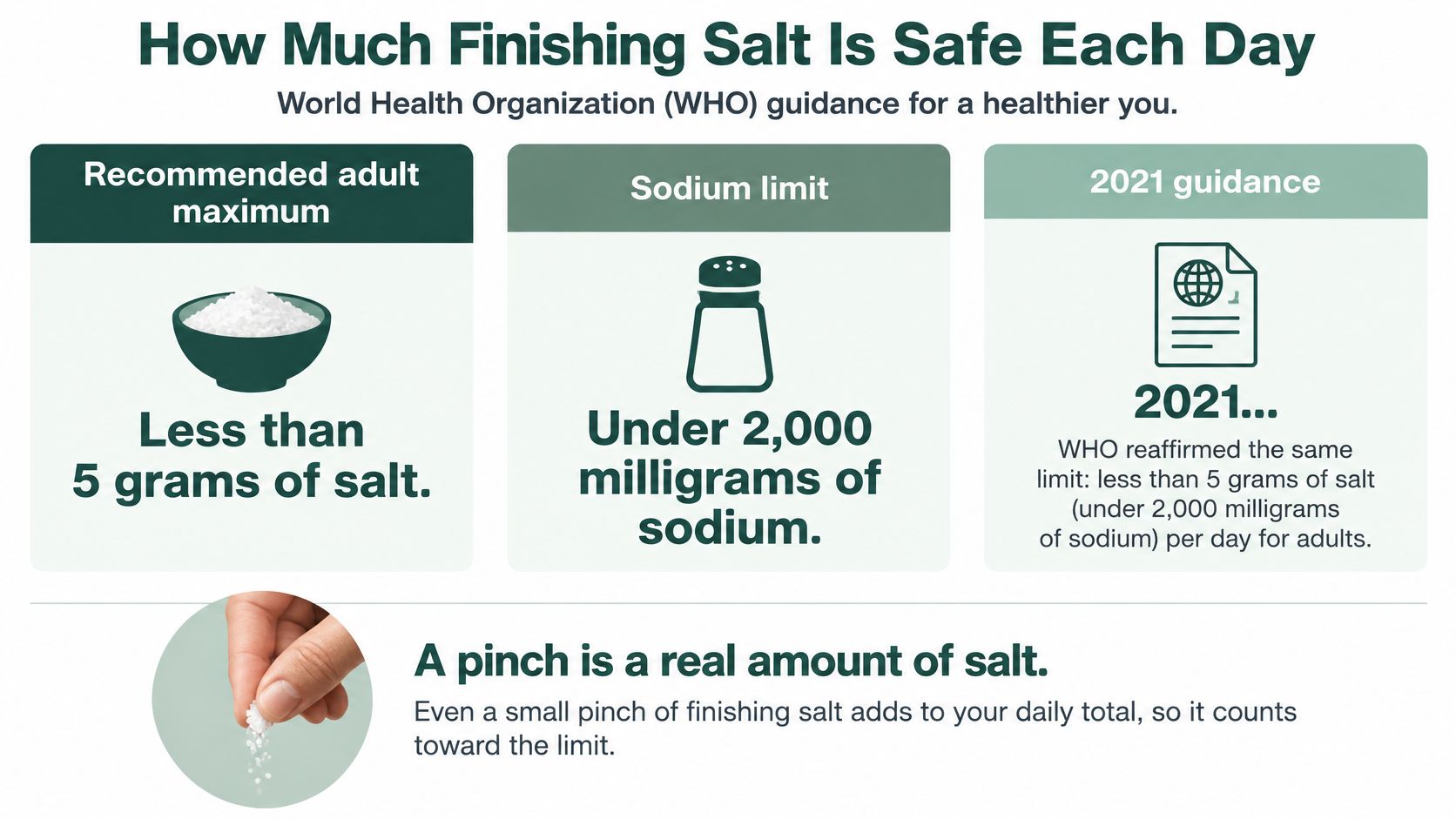
A finishing pinch adds measurable sodium to the meal. The World Health Organization recommends fewer than 2,000 milligrams of sodium, equivalent to less than 5 grams of salt, per adult daily, and estimates that the global adult mean in 2021 was 4,278 milligrams of sodium, approximately 11 grams of salt. That average exceeds the recommended limit. The World Health Organization sodium-reduction fact sheet explains both figures.
| Measure | Meaning for finishing salt |
|---|---|
| Recommended adult intake | Covers salt from the whole diet, not just the salt cellar |
| Global average intake | Describes population consumption, not an individual target |
| A finishing pinch | Adds to sodium from cooking salt, condiments, and prepared food |
| Individual dietary advice | May call for a plan specific to your health needs |
Measure your pinch instead of guessing
Salt contains approximately 400 milligrams of sodium per gram, so the weight of a pinch matters. Broad flakes and compact grains settle differently between the fingers or in a spoon. Appearance alone cannot tell you how much salt, and therefore sodium, a pinch contributes.
Calibrate your usual pinch with a kitchen scale that can measure small amounts. Tare a dry dish, add several pinches of the salt you use, then divide the combined weight by the number of pinches. The result describes your own handling of that salt, not a universal conversion.
Keep a short food log as you learn the portion. Include cooking salt, finishing salt, and sodium listed on packaged-food labels. A garnish measurement alone leaves out much of the meal's total.
A better budget: Decide how much salt belongs in the complete meal before deciding where to place it.
Flavor efficiency doesn't change sodium intake
WHO identifies high sodium intake as a contributor to raised blood pressure, which increases cardiovascular risk. A concentrated surface garnish can make a small amount noticeable, but it still adds sodium. Its effect on your total depends on how much you use and what else is in the meal.
Account for salt in the cooking base before adding a finishing pinch. Leave room for a garnish only if the plated food needs it, and count the salt that reaches your serving. If a clinician has prescribed sodium limits, follow that individual guidance rather than using a general population recommendation as your personal target.
What to Check Before You Buy
A useful label tells you what's inside the jar and how you can use it. Attractive packaging and a named coastline are helpful context, but neither answers every quality question.
A label checklist that supports a decision
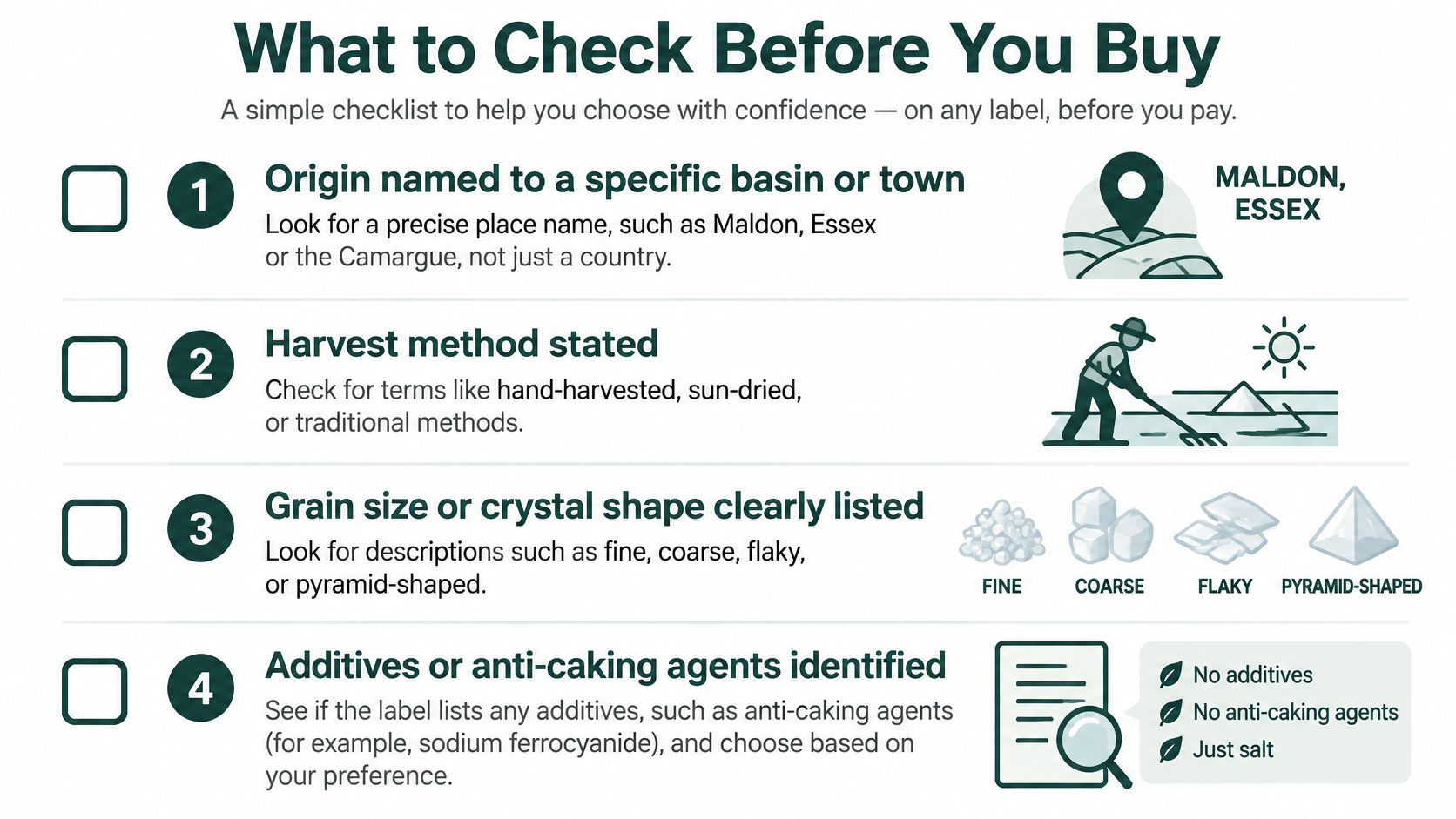
- Identify the place and producer. Look for a named basin, town, or harvesting area, rather than a country alone; distinguish sea, lake, and mined salt.
- Read the harvest description. Hand-skimmed surface crystals and coarse evaporated salt describe different products, even when they share an origin.
- Find the crystal form. Look for plain descriptions such as fine grains, thin flakes, moist crystals, or dense coarse grains, then match that form to your usual dishes.
- Check ingredients and testing transparency. Identify smoke flavorings, herbs, and anti-caking agents, and look for published contaminant results. If results aren't public, record that as unknown rather than assuming either purity or contamination.
- Plan storage. Choose a container you can close and keep away from steam; preserve the intended moisture of fleur de sel rather than trying to dry it indiscriminately.
- Interpret variation carefully. Our handcrafted or seasonal products may vary in color, flavor, texture, shape, finish, packaging, or natural sediment, and such variation isn't ordinarily considered a defect. That doesn't make every unexpected change acceptable.
What contaminant findings can and can't tell you
A global study of 39 commercial salts published in Environmental Science & Technology reported microplastic concentrations in sea salts from 0 to 1,674 particles per kilogram, with an outlier reaching 13,629 particles per kilogram. These findings don't establish a specific health outcome from an ordinary finishing pinch or identify the contents of an untested jar. They do justify rejecting the assumption that natural or hand-harvested automatically means purer.
Use our fleur de sel, sea salt, and kosher salt comparison to clarify the category before comparing products. Then write the checklist answers beside price per gram, calculated by dividing the jar price by its net weight in grams.
Compare the salt rather than the total weight of a ceramic vessel. A jar you'll refill may have value, but that's a separate purchase consideration from the seasoning inside it.
Choosing Your First Finishing Salt
Start with the salt that fits the meal you cook most often. A finishing salt earns a place in your kitchen when its crystal size works for that food and you can apply it consistently. Origin can add character, but it is not a ranking system.
Which finishing salt to buy first
| Situation | Start with | Why |
|---|---|---|
| Everyday eggs, vegetables, and salads | One flaky or Maldon-style salt | Adds noticeable crunch and a visible finishing accent |
| Delicate butter, eggs, and warm vegetables | Fleur de sel with moist crystals | Gives a delicate crystalline finish; a smaller jar lets you assess its texture |
| Regional character | Camargue or Ibiza salt | Offers a point of comparison once you use a first salt regularly |
| Gifting | A contrasting salt pair | Lets the recipient compare different styles |
| Cooking in the pot | Everyday cooking salt | Keeps a finishing salt available for use at the table |
Choose a reference before adding variety
For a general-purpose first purchase, choose plain flakes without added aroma. Their texture is easy to assess across savory dishes and desserts, without smoke or herbs complicating the comparison.
Choose fleur de sel if you often serve buttered bread, eggs, or gently cooked vegetables. Its delicate crystals are suited to a finishing pinch. Start with a smaller jar while you learn which moisture level and crystal size you prefer. A large quantity makes little sense until you know how often you will use it.
Compare regional salts on a familiar dish, keeping the amount and food consistent. That way, origin is context for the tasting, not a substitute for judging how the salt's crystals feel and season. Try European tomato toast with Ibiza salt as a serving idea.
Make a gift a comparison
The Les Terres Blanches Fleur de Sel Duo Gift Set costs $72.00. It offers a paired tasting for someone interested in comparing fleur de sel styles. The recipient can assess each salt on the same food rather than treating regional origin as a verdict on quality.
Use the table to match one salt to your most-cooked dish, then try it regularly before choosing another. Let the next purchase address a different preference, such as a crunchier texture or a more delicate finish.
Lello.Store offers finishing salts, pantry essentials, and practical guides that connect ingredients to dishes. Explore Lello.Store for a salt suited to your everyday cooking or a side-by-side tasting gift.