

You've bought good pistachios, you're ready to blend, and you're wondering why your last batch turned oily, dull, or barely tasted of nuts at all. That's the usual problem with pesto di pistacchi. The ingredient list is short, so there's nowhere to hide a harsh roast, warm nuts in the processor, or oil poured in all at once. Get the nut stage right and the rest is simple seasoning. Get it wrong and even expensive Bronte pistachios won't save it.
Table of Contents
- Pistachio Pesto Ingredients and Quantities
- Choosing Pistachios From Bronte to the Supermarket
- How to Make Pistachio Pesto Step by Step
- Variations That Keep the Pistachio Flavor
- Pairing Pistachio Pesto with Pasta and Appetizers
- Storing Pistachio Pesto and Making Your First Batch
Pistachio Pesto Ingredients and Quantities
For about 150 g of finished pesto, use 100 g shelled, unsalted pistachios, 60 to 80 ml extra virgin olive oil, and 30 g finely grated Parmigiano Reggiano or Pecorino Romano, plus the small extras below. The nuts carry nearly all the flavor, color, and body. Everything else should frame them, not compete with them.
That's why I keep garlic and herbs optional and modest. A heavy handful of basil turns this into basil pesto with pistachios in it. Too much cheese makes it salty and grainy before you notice the sweet, resinous nut flavor.
Ingredients for a 150 g Batch of Pistachio Pesto
| Ingredient | Amount for about 150 g pesto | Role | Notes |
|---|---|---|---|
| Shelled, unsalted pistachio kernels | 100 g | Nutty body and green color | Raw or lightly roasted; skip salted or pre-flavored nuts |
| Extra virgin olive oil | 60 to 80 ml | Carries flavor and sets texture | Mild, fruity oil; add in a thin stream |
| Parmigiano Reggiano or Pecorino Romano, finely grated | 30 g | Salt and savoriness | Pecorino gives a sharper finish; omit for dairy-free |
| Fresh basil or mint leaves | 10 g, a small handful | Lift and green aroma | Optional; mint suits the lemon version |
| Garlic clove | 1 small, optional | Sharp backbone | Blanch for 1 minute or leave out |
| Lemon zest | 1/2 lemon | Brightness | Zest only; add juice at the end |
| Fine sea salt | 1/4 tsp, to taste | Seasoning | Taste after the cheese, which adds salt |
| Pasta cooking water or warm water | 1 to 2 tbsp | Loosens and emulsifies | Add last, one spoonful at a time |
Read the table in the order you'll use it. Nuts go in first and get milled alone. Cheese, garlic, zest, and salt follow in short pulses. Oil comes next, slowly, and water comes last when you can already see the texture you're adjusting.
If you're choosing an oil for this, a mild, fruity bottle works better than a fiercely peppery one, and our guide to choosing extra virgin olive oil explains how to tell them apart. You want the oil to carry the nut, not shout over it.
Working rule: Start with 60 ml oil per 100 g nuts. Add spoonfuls until the paste spreads easily and looks glossy. Nut oil content changes from batch to batch, so the last 20 ml is a judgement, not a promise.
For a dairy-free batch, drop the cheese, add a teaspoon of lemon juice, and use a pinch more salt. Don't replace cheese with extra herbs, or you'll lose the point of the sauce. Garlic is optional here. One small clove, blanched for a minute, gives backbone without raw bite, and leaving it out lets the pistachio stay in front.
A finished paste should be pale sage green, glossy, and spreadable, with visible nut flecks. If it looks like smooth green paint, you've processed it too far. If oil pools on top right away, you've added too much, too fast.
Choosing Pistachios From Bronte to the Supermarket
A supermarket bag of raw kernels and a vacuum pack stamped Bronte will both blend into a green sauce. They won't taste the same, and the size of that price gap is the first thing to understand before you shop.
Bronte pistachios from the western slopes of Mount Etna carry the Pistacchio Verde di Bronte DOP label, and El País reporting on the Bronte harvest notes that the product has held European Protected Designation of Origin status since 2004, with reported prices of approximately €55 to €60 per kilogram in 2025.
Scarcity explains most of the gap. The trees grow slowly on Etna's rough volcanic slopes, yields stay small, and a heavy crop one year tends to be followed by a light one, so supply arrives in waves rather than a steady flow. You're paying for a protected origin, a limited harvest, and a distinctly sweet green nut. The label guarantees provenance. Roasting and milling stay on your side of the deal.
Pistachio Options for Pesto and What Each One Suits
| Option | What to look for | Price signal | Best use |
|---|---|---|---|
| Pistacchio Verde di Bronte DOP (Sicily) | Protected origin label, bright green, sweet flavor | About €55 to €60/kg reported in 2025 | Pesto where the nut is the whole dish |
| Other Italian or Sicilian pistachios | Italian origin; label may not name Bronte | Premium, below DOP Bronte | Everyday pesto with good flavor |
| Iranian, Turkish or US raw kernels | Widely sold, steady supply | Commodity to mid-range | Budget batches; roast with care |
| Pre-roasted or salted pistachios | Convenient and already seasoned | Supermarket snack pricing | Avoid; salt and extra roast skew the sauce |
Reach for DOP Bronte when pesto di pistacchi is the dish itself, tossed through plain pasta or spread on warm bread with nothing competing. Other Italian or Sicilian pistachios handle everyday batches well for a less painful bill. Iranian, Turkish, or US raw kernels make a perfectly good budget pesto if you roast them gently yourself, and a careful hand at the tray narrows the gap more than any label widens it.
I wouldn't buy pre-roasted or salted pistachios for pesto. You can't undo the salt, and a second roast in a hot processor pushes the nuts toward bitterness. Whatever you choose, season at the end with a salt you dose yourself. The story behind Sicilian sea salt and how it's harvested is a reminder that salt has provenance too, though the practical point here is simpler. Add it last and taste.
Before you pay, run three checks:
- Unsalted and plain: Raw or lightly roasted kernels, with no added salt or flavoring.
- Bright green color: Look for green kernels through the pack window; grey or yellow points to age.
- Recent pack date: Old nuts taste flat and can lean rancid, and no amount of lemon fixes that.
Save the Bronte for the nights the nut carries the whole plate. For a midweek batch where cheese and lemon share the stage, a fresh everyday kernel takes you most of the way.
How to Make Pistachio Pesto Step by Step
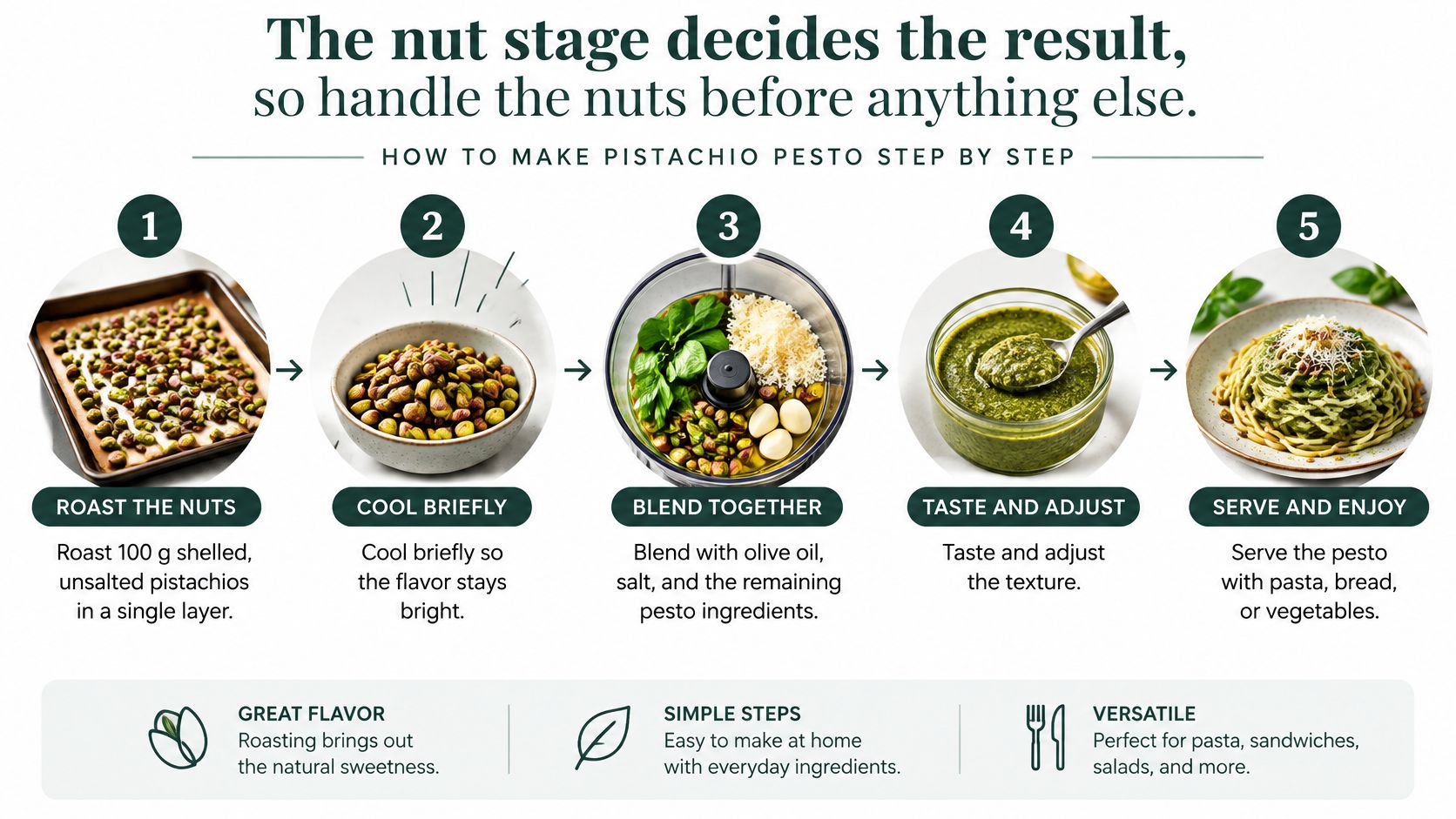
The nut stage decides the result, so handle the pistachios before anything else. Cheese, oil, and herbs cannot repair scorched or overheated nuts. A DOP label guarantees where the pistachio was grown and how it was farmed; what happens in your oven and your processor is entirely on you. Work in this order and do not rush the cooling step.
Roast, Cool, and Mill the Nuts
- Roast the pistachios. Spread 100 g shelled, unsalted pistachios in a single layer on a tray. Published pistachio-paste work in a peer-reviewed study on pistachio paste processing reports roasting at approximately 170 to 190 °C for 8 to 10 minutes, which is a sound home range. Shake the tray once, and watch the last minute closely. The nuts should smell toasted and the skins should deepen slightly. A crowded tray roasts unevenly, and green flavor scorches fast.
- Cool them properly. Tip the nuts onto a cold plate and leave them for about 10 minutes, until they are no longer warm to the touch. Warm nuts release oil as soon as the blades hit them, and that is how you get a greasy paste instead of a creamy one. This is the step people skip, and it is the one that costs them.
- Pulse to a fine crumb. Put the cooled nuts in a food processor and pulse in 1-second bursts, scraping down the bowl between pulses. Short bursts limit localized heating and keep the grind even. If you let the motor run from the start, the nuts at the blade turn to butter while the ones at the edge stay coarse.
- Process to a paste, then stop. Run the machine continuously for 15 to 30 seconds more, and stop when the paste coats a spoon but still keeps slight texture. That is the benchmark. Over-milling releases excess oil and produces a heavy emulsion that sits on pasta instead of coating it.
Season, Emulsify, and Loosen
- Add the aromatics and cheese. Add the garlic, if you are using it, and the lemon zest, and pulse once. Add 30 g cheese and the salt, and pulse for about five seconds. Long processing at this point warms the cheese and can make the texture claggy.
- Stream in the oil. With the motor running, pour in 60 to 80 ml olive oil in a thin stream over about 30 seconds. Adding it all at once is a common slip, because the paste cannot take it up evenly and you end up with oil floating around nut crumbs. Start at 60 ml and judge from there.
- Loosen and taste. Add 1 to 2 tablespoons of warm water or pasta cooking water, one spoonful at a time, until the pesto drops slowly from a spoon. Taste for salt and lemon and adjust in small amounts. Serve it soon, or jar it straight away.
If you want lemon aroma at the table without extra juice loosening the sauce, a finishing mist does that job. Mantova Sicilian Lemon Extra Virgin Olive Oil Spray, 8 oz combines extra virgin olive oil with Sicilian lemon essential oil in a controlled spray, so it adds fragrance and gloss rather than acidity and water.
The roast level is a real choice, not a fixed rule. A gentler, longer roast keeps fresher green notes in the finished sauce, while the hotter, shorter roast above gives a toastier, darker result. Push the heat too far and the browning and roasted aroma build quickly, but the fresh flavor you paid for starts to flatten out. For a first batch, I would work at the hotter end of the range, note your temperature, time, and nut weight, and change one variable on the next run. Consistency comes from recording what you did, not from memory.
Variations That Keep the Pistachio Flavor
Keep the nut, oil, and salt base fixed and change one lever at a time. Change two or three things at once and the pistachio disappears under them, and you won't know which change did it.
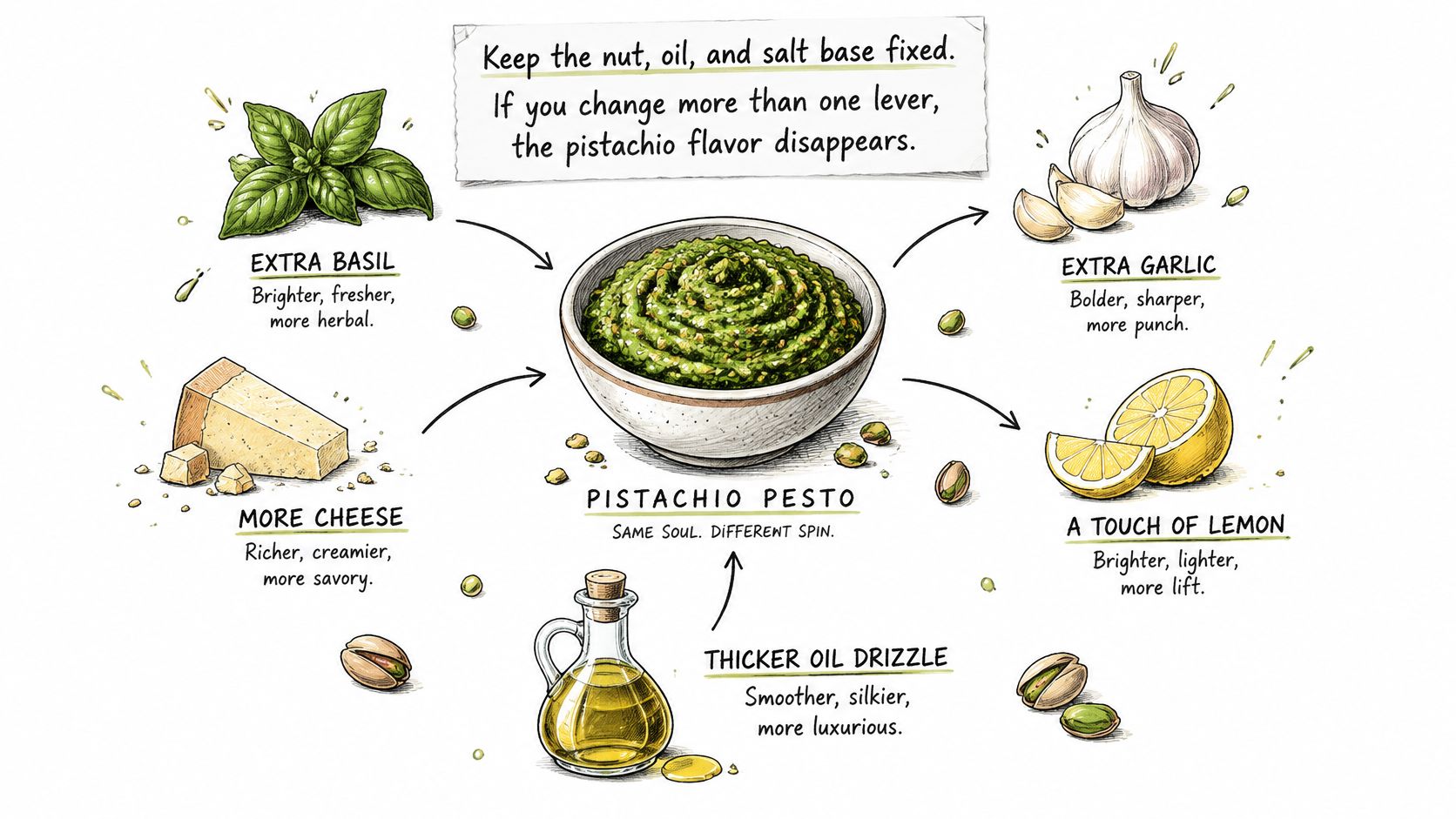
- Lemon and mint: Add the zest of half a lemon and 10 g mint leaves. Use it on grilled fish or summer vegetables, where the freshness earns its place. If basil is your lever instead, our guide to basil olive oil and how to use it shows how basil behaves as a finishing flavor rather than a bulk ingredient.
- Pecorino-led: Swap the Parmigiano for 40 g Pecorino Romano. The finish is sharper and saltier, which suits a plain pasta sauce. Cut the added salt back and taste before you season.
- Dairy-free: Drop the cheese and add an extra spoonful of oil, a squeeze of lemon juice, and a pinch more salt. The texture loosens slightly and the nut flavor reads cleaner.
- Sun-dried tomato: Add 2 tablespoons of finely chopped oil-packed sun-dried tomatoes and cut the olive oil by 1 tablespoon. This one's built for bruschetta, where the tomato acidity cuts the richness.
- Lower-cost stretch: Replace 30 g of the pistachios with blanched almonds. It works, and it saves money, but be honest about the trade-off. The pistachio flavor fades as the almond share rises, so I wouldn't push past that proportion.
Watching the texture change as you adjust one ingredient helps more than reading about it, so use the short demonstration below as a visual check while you work.
One last softening trick. A spoonful of fresh ricotta folded through a finished batch makes it gentler and more spreadable for crostini without changing its character. Add it at serving time, not before storage.
Pairing Pistachio Pesto with Pasta and Appetizers
Pistachio pesto is thick and rich, so pasta needs a shape that holds it and starchy water to loosen it. Toss it off the heat, always. A hot pan makes the oil greasy and dulls the roasted nut flavor, which is the thing you paid for when you chose good pistachios.
Pasta Matches
- Short ridged shapes: Trofie, fusilli, and casarecce trap a thick pesto in their folds. If you're shopping for short shapes, our notes on dried orecchiette pasta cover how cupped shapes catch sauce, and the same logic applies here.
- Long strands: Tagliolini or spaghetti take a loosened sauce well, because the strands need the pesto thinned enough to coat rather than clump. Flour + Water Organic Spaghetti, at $15.00, is a reliable pick for this once the pesto is loosened properly.
- The ratio: Use about 2 to 3 tablespoons of pesto per 100 g dry pasta, tossed with 1 to 2 tablespoons of cooking water. Start with less than you think, then loosen gradually with more water. A bowl that comes out too rich is hard to fix once it's plated.
Appetizers and Small Plates
- Crostini: A thin layer on toasted bread with shaved cheese on top. Thin is the operative word, because the paste is concentrated.
- Bruschetta: Ripe cherry tomatoes and a pinch of flaky salt over the pesto. The tomato acidity does the balancing work.
- Filled cherry tomatoes: Spoon pesto into halved tomatoes and finish with crushed pistachios for a second layer of texture.
- Warm chicken or white fish: A spoonful over sliced chicken or fish after roasting, never before, since direct heat mutes the aroma.
- A cold platter: Prosciutto or mortadella alongside, with a crisp white wine.
The contrast rule covers all of it. Pair the rich nut with acid, such as tomato or lemon, and with something crisp, and keep it away from other heavy sauces. A mild, fruity olive oil in the batch itself leaves room for those sharper plate partners to do their job.
The most common serving mistake is using pesto straight from the fridge. Cold oil tightens and the aroma stays muted. Let the jar sit out for about 15 minutes before serving and stir it once.
Storing Pistachio Pesto and Making Your First Batch
The fridge buys you a few days, the freezer buys you months, and an oil layer on the surface slows oxidation while the paste underneath stays perishable. Fresh pesto di pistacchi behaves like any other oxygen- and temperature-sensitive emulsion. PubMed-indexed research on olive-oil-based pesto found that an olive phenolic extract delayed rancid off-flavor volatile accumulation for up to 7 days after opening compared with a control, which shows how much antioxidant composition matters. A home jar runs under different conditions, though: a different oil, fresh cheese in the mix, and a spoon that comes and goes. Stay conservative.
Conservative Storage Times for Pistachio Pesto
| Method | Container and conditions | Conservative timeline | Notes |
|---|---|---|---|
| Refrigerated | Small airtight jar, oil on top, clean spoon | Up to 3 days | Keep the surface covered; seal promptly after each use |
| Frozen | Flat portions in freezer bags or ice cube trays | Up to 3 months | Thaw in the fridge overnight; stir in any separated oil |
| Room temperature | Table or counter during service | 2 hours maximum | Discard after service; never re-chill |
For the fridge, use a clean, narrow container with minimal headspace. Level the surface, cover it directly with film or a thin layer of oil, seal it, and refrigerate promptly. Use a clean spoon every time. A spoon that touched bread or raw food shortens the window, and so do fresh cheese and fresh herbs in the mix.
Browning worries people more than it should, and in the wrong way. A dull or darker surface means oxygen reached the paste and freshness slipped, and a cover of oil or film slows that down. The safety test runs simpler: discard any pesto that smells sour, shows mould or fuzz, or has sat out past the service window. When in doubt, throw it out and make a smaller batch next time. If you're sorting out what belongs in the fridge generally, our pantry rules on what to refrigerate give the broader framework.
Don't judge a jar by its green color. A bright jar can still be tired, and a slightly darkened top layer can be fine underneath. Time, temperature, and a clean spoon are the tests that matter.
For your first batch, make the 150 g quantity, serve 2 to 3 people, and keep only what you'll eat within three days in the fridge. Freeze the rest flat in labelled portions the same day, while it still tastes fresh. The sauce takes about ten minutes to make, so a fresh second batch beats stretching an old one, and the care you put into roasting and milling the nuts pays off only while the jar is handled right.
Label anything you share or gift. Pistachios are tree nuts and Parmigiano contains milk, and both need stating plainly on a shared dish, even when the pesto looks harmless and green.
Stock your pantry for the next batch at Lello.Store, where you'll find bronze-die pasta, mild extra virgin olive oils, and finishing salts chosen from small makers with named provenance. Pair them with good unsalted pistachios and the method above, and you'll have a pesto that tastes of the nut you paid for.