

You've got a bowl of ripe peaches on the counter, a jar of amaretto in the cabinet, and the practical question is simple, what can you make that tastes elegant without turning into a guesswork preserve? The answer is amaretto peach jam, but only if you treat the liqueur as flavor inside a tested jam process, not as a shortcut that changes the rules of canning.
Table of Contents
- Why Amaretto Works So Well with Peaches
- Choosing Peaches and Gear Before You Start
- Cooking the Jam with a Tested Pectin Formula
- Preserving It Safely with the Right Process
- Cutting Sugar Without Breaking the Set
- Serving Amaretto Peach Jam at the Table
- Storage, Spoilage Signs, and Quick Answers
Why Amaretto Works So Well with Peaches
A spoonful of amaretto fits peaches because the flavors already share some of the same family traits. Peaches are drupes, and so are apricots, cherries, almonds, and olives. That matters here because drupes often carry almond-like notes from their pits or kernels. Britannica notes that amaretto may be made from alcohol infused with stone-fruit pits or almonds, and some versions include peach pits, vanilla, cardamom, and allspice. That is why the pairing reads as layered fruit, not just extra sweetness. Britannica's amaretto overview
The flavor bridge matters more than the legend
You may hear the old Saronno story about 1525, when the drink was supposedly offered to Bernardino Luini. It belongs to the drink's cultural memory, but treat it as a founding legend, not a verified commercial starting point. The clearer historical marker is the early 1900s, when the Reina family began bottling the liqueur for sale, with exports outside Italy beginning in the 1960s as amaretto spread into other markets.
That history is interesting, but jam makers need the flavor logic. Amaretto should sit behind the peach, not in front of it. Used in a measured amount, it can strengthen peach aroma and add almond-like depth without turning the jar into candy. The same idea applies in other foods where a small amount of a rich ingredient carries the flavor of the whole, much as fat carries flavor in this chocolate-and-olive-oil discussion.
Practical rule: if the finished jam smells like dessert syrup instead of peaches, you have used too much liqueur.
Timing matters too. Add amaretto too early and some of the aroma can cook off. Add it late, in a measured amount, and it works like a finishing note instead of a blunt ingredient. I have made this style of jam enough times to know the difference shows up the moment you open the jar.
Choosing Peaches and Gear Before You Start
A good jar starts at the fruit bowl. Choose fully ripe, freestone peaches that give slightly at the stem and smell like fruit, not grass. Overripe peaches bring watery pulp and a softer set, while underripe fruit leaves the jam flat and harder to balance.
White peaches are the one fruit choice I would avoid here. Some white peaches can exceed pH 4.6, and they do not have safe canning recommendations in the validated framework, so they are a poor fruit for improvising a shelf-stable preserve. Stick with standard ripe peaches and, when possible, weigh them so the batch stays close to the tested formula rather than whatever looks right by eye.
Set out the tools before the fruit hits the board
You do not need a large setup, but you do need the right pieces ready before the pot heats up. I keep a heavy-bottomed pot, thermometer, wooden spoon, half-pint jars with two-piece lids, a boiling-water canner, jar lifter, and a chilled plate for the set test within reach.
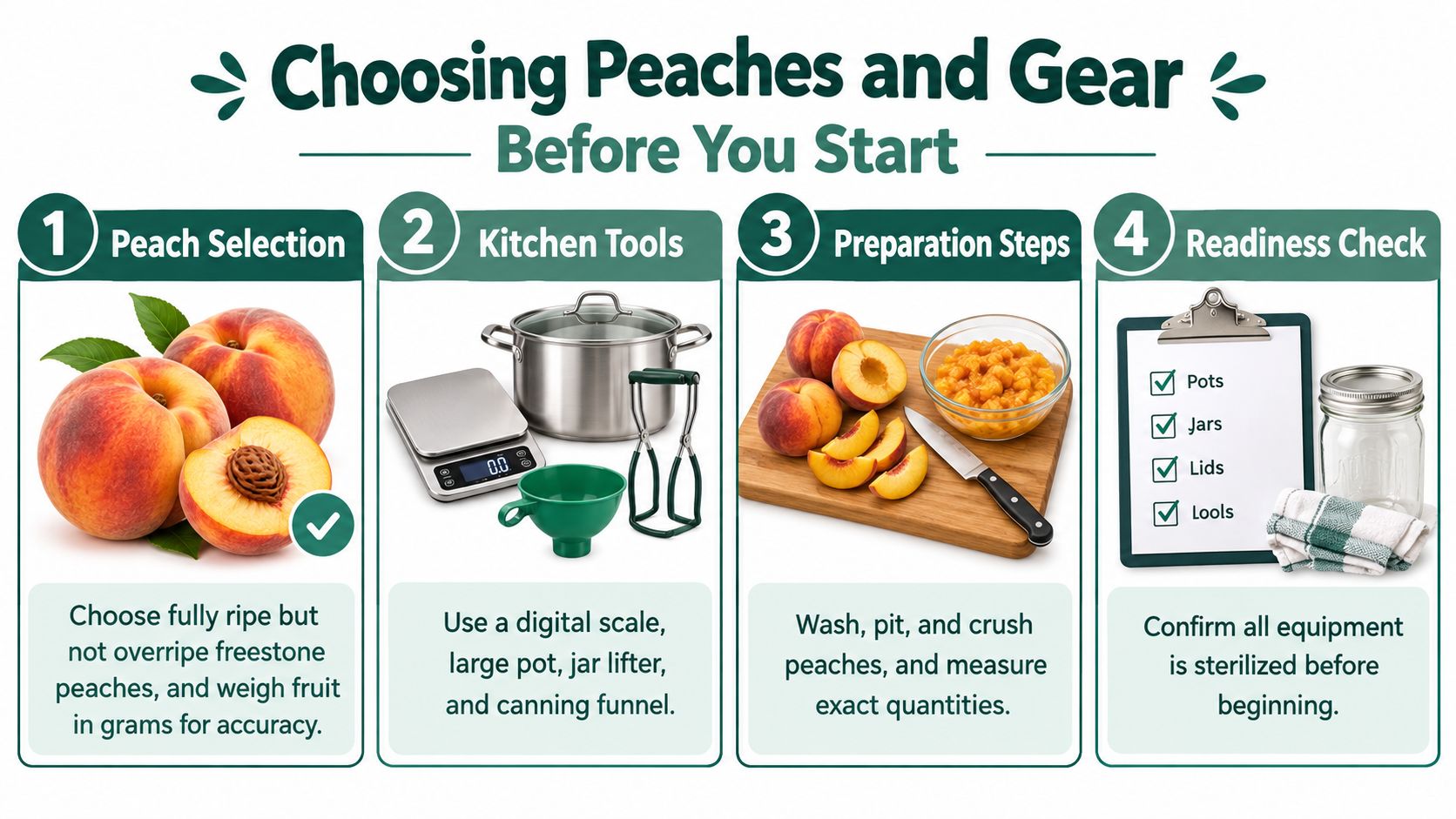
Use a digital scale if you have one, because weight keeps the fruit ratio steady from batch to batch. Wash, pit, and crush the peaches before measuring anything else, then confirm the jars, lids, funnel, and canner are ready. If one piece is missing, pause and get it before the fruit goes on the heat.
A clean prep station saves more jam than a clever substitution does.
For a pectin-based batch, consistency matters most. If you want to compare set jam with a looser style, this jam-or-confit guide explains the difference clearly. The same prep discipline still helps if you make a no-added-pectin version, because the fruit will need tighter control over concentration and cooking. That is why the tools matter as much as the peaches.
Cooking the Jam with a Tested Pectin Formula
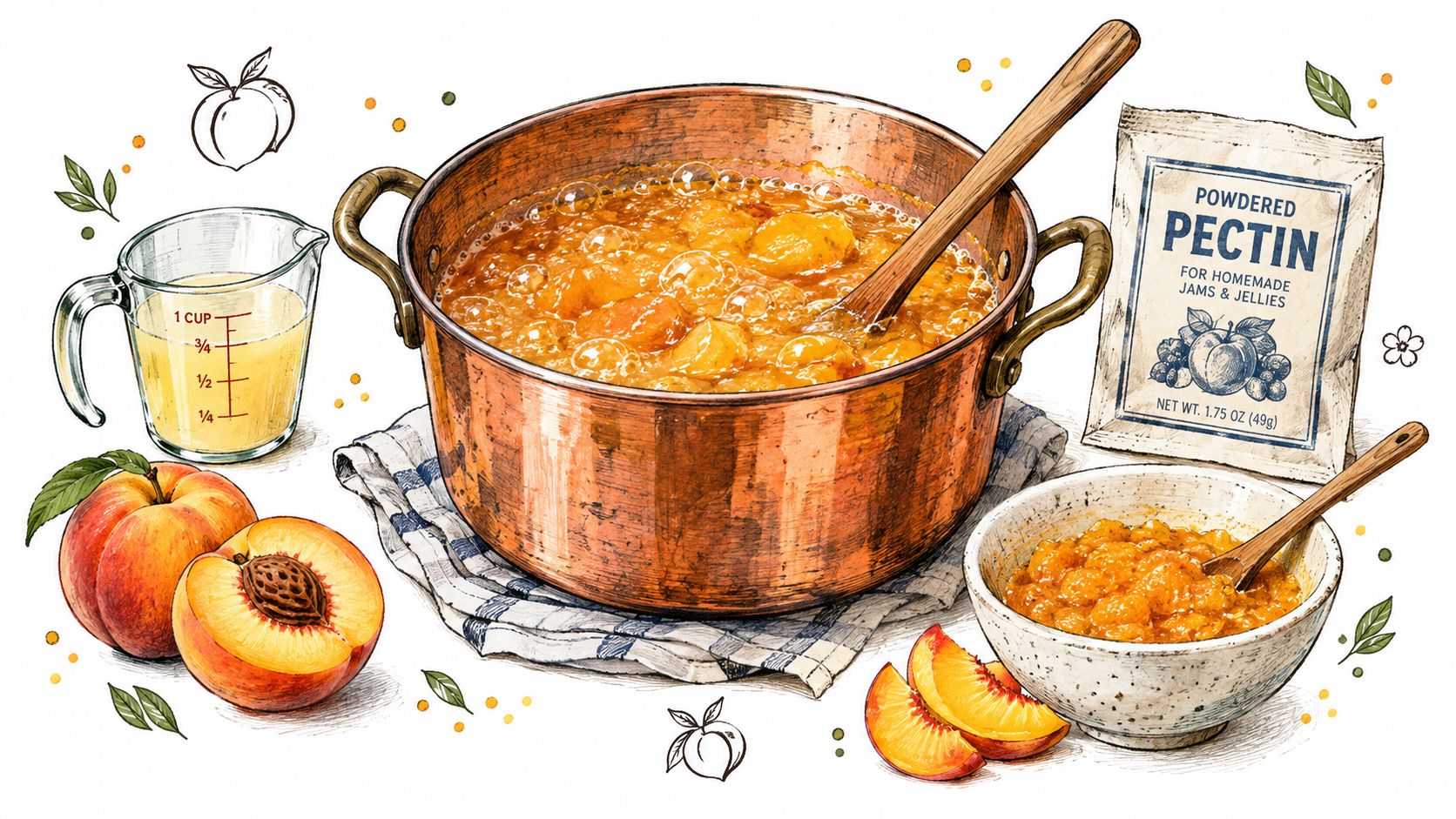
A jar of amaretto peach jam only behaves well if the base recipe is sound first. Start with the tested peach-jam framework from the National Center for Home Food Preservation, then treat amaretto as a flavor note inside that structure, not a shortcut around it. The validated ratio is about 3¾ cups crushed, fully ripe peaches, ¼ cup lemon juice, one package powdered pectin, and 5 cups sugar. NCHFP peach jam guidance
Follow the two-boil sequence exactly
Combine the peaches, lemon juice, and pectin first, then bring the mixture rapidly to a full rolling boil with bubbles across the entire surface. Add the sugar only after that point, then return the pot to a hard boil for exactly 1 minute while stirring continuously.
That order matters because pectin needs the right sugar-acid-heat balance to gel properly. If you stop short on the second boil, the jam may stay loose. If you change the sequence, you change the chemistry that gives the set its structure.
Add the amaretto only as a late-stage flavoring adjustment or after the boil, in the amount that still fits the tested formula. Alcohol changes evaporation, flavor concentration, and final solids, so an untested splash is not just a taste choice, it can change the batch in ways the safety guidance does not account for. NCHFP peach jam guidance still applies here: keep the tested ratio intact and treat the liqueur as an accent.
One mistake I see often is batch inflation. Do not double the recipe because your pot looks roomy. Tested formulas are written for a reason, and doubling is one of the fastest ways home cooks break the set and the processing assumptions at the same time. If you want more jars, make a second full batch.
A small note on timing and aroma
Amaretto works best as a measured accent. Add it late, and you keep more of the almond and stone-fruit character that makes the jam smell rich without turning it into a liqueur spread. That is the version I reach for when I want a jar that can sit between breakfast spread and dessert topping.
Stir constantly after the sugar goes in, because scorched jam tastes flat no matter how good the peaches were.
For a fuller editorial comparison of preserve styles, the distinction between cooked jam and a looser spread is useful, and this preserve guide gives a clear side-by-side look at the difference.
Preserving It Safely with the Right Process
A jar of amaretto peach jam can look finished on the counter and still belong in a completely different storage category. The safety choice comes first. If you want a shelf-stable jar, use a validated boiling-water canning process. If you want to loosen the sugar or treat the alcohol as a flavor accent without changing the process, keep the jam refrigerated or freeze it. Amaretto adds aroma, but it does not replace acidity, headspace, processing time, or the rest of the tested canning framework.
Choose the storage method first
A sealed, properly processed jar belongs in the pantry, as explained in this guide to what to refrigerate. A fresh batch that was never canned belongs in the refrigerator. A freezer version belongs in the freezer. That simple split keeps gift jars and personal batches from being handled as if they were all the same.
The tested no-added-pectin style gives a useful benchmark here. Oregon State University Extension describes a batch built from 2 quarts crushed, peeled peaches, ½ cup water, and 6 cups sugar, with enough yield for about 8 half-pint jars. Their method cooks the peaches and water gently for 10 minutes, then adds the sugar gradually and cooks the mixture rapidly for about 15 minutes while stirring often. That is the kind of process you can follow when you want the preserve to behave predictably.
| Boiling-Water Processing Time by Altitude | Processing Time |
|---|---|
| 0–1,000 feet | 5 minutes |
| 1,001–6,000 feet | 10 minutes |
| Above 6,000 feet | 15 minutes |
Those processing times do not change because amaretto is in the pot. Altitude still decides how long the jar stays in the canner.
Tell recipients what the jar is
That matters for gifting. Heat can reduce alcohol, so a jar labeled “contains amaretto” may finish with little alcohol left after processing. If someone avoids alcohol for dietary, cultural, or personal reasons, the label should say so plainly.
Gift rule: if it hasn't been boiling-water canned, say so plainly on the label.
If you are pairing the jar with a pantry gift, a finishing salt set like Les Terres Blanches Fleur de Sel Duo Gift Set fits a different storage category from preserved fruit. Salt keeps differently from jam, so the shelf message stays clear.
Check the finished jar the same way every time. The lid should seal, the color should stay clear rather than murky, the smell should remain fruity, and there should be no mold, fizz, or leakage. If any of those signs show up, do not taste around the problem. Discard the jar.
Cutting Sugar Without Breaking the Set
People ask for less sugar in jam all the time, and I understand why. The problem is that sugar in a preserve is doing more than sweetening. In a tested formula, it helps with gel formation, water control, and texture, and depending on the recipe, it also supports preservation. Cut it casually and you may end up with a loose spread that won't set and shouldn't be processed as if nothing changed.
Three different products, not one compromise
A classic amaretto peach jam follows the tested pectin formula and gives you the most reliable shelf-stable result. A refrigerator compote-style spread can use less sugar, but it's a different product and should be stored as such. A reduced-sugar pectin jam needs a pectin specifically blended for low-sugar use, plus the manufacturer's instructions, not a random half-measure.
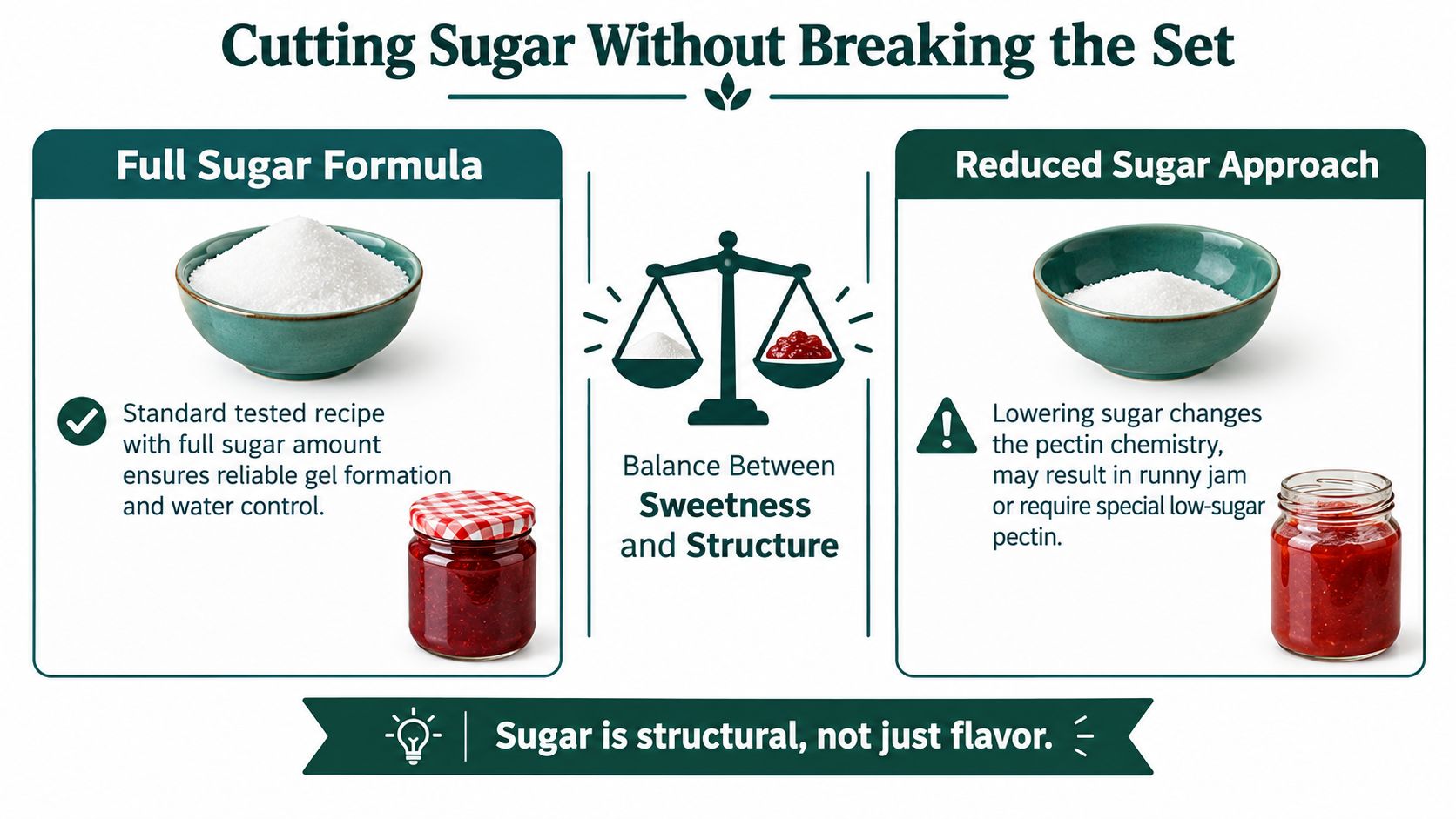
That's the part most recipe posts skip. “Less sugar” sounds simple until you see what it does to the set. The liqueur can make the jam taste fuller because its almond and caramel notes read as richness, but it doesn't stand in for sugar's structural work.
If you want a fruit preserve that feels more restrained, portion size is often the smarter move. A spoonful on toast, a smaller serving beside cheese, or a refrigerated spread labeled clearly can solve the problem without forcing a shelf-stable recipe into a form it wasn't built for. Mordor Intelligence market coverage
For a fruit preserve you can compare against, Les Confitures à l'Ancienne Wild Blueberry Jam is a straightforward blueberry conserve that stays centered on fruit, which is useful to keep in mind if you're deciding whether you want an actual jam, a softer spread, or something for breakfast and baking.
Bottom line: don't reduce sugar in a shelf-stable jam unless the formula is built for it.
Serving Amaretto Peach Jam at the Table
A jar of amaretto peach jam belongs wherever fruit, butter, dairy, or toasted bread already make sense. On a cheese board, I like it in small spoonfuls beside Brie, goat cheese, Manchego, or a blue, because the peach lifts the cheese and the almond note softens the salt and fat. If you already use fig jam for that job, peach with amaretto does a similar thing but feels brighter and less dense. What to eat with fig jam
Keep the pairings simple first
Start with toast and butter. Then try yogurt. Then move to pastry. The jam doesn't need a complicated plate to work, and the cleaner the base, the easier it is to taste the amaretto without burying the fruit.
For breakfast, warm bread is the easiest home for it. Croissants, scones, and split biscuits all take to a thin layer of jam, especially if you want a breakfast that feels a little more composed than butter alone. A spoonful folded into plain yogurt is another good use because the tang keeps the sweetness honest.
Use it where peach belongs, not everywhere
Dessert is where the jar becomes especially useful. Spoon it over vanilla ice cream, swirl it into cheesecake batter, or tuck it into thumbprint cookies. A thin glaze on roast pork or turkey also makes sense, provided you keep the layer light and let the fruit, not the sugar, do the talking.
If you like a brunch drink, a tiny spoon in a mimosa-style glass with prosecco can work, but keep the amount small. You want the peach-almond character, not a sweet cocktail in disguise. The same rule applies at the table as in the pot, use enough to be noticed, not enough to take over.
Think of it as a condiment with dessert manners.
Storage, Spoilage Signs, and Quick Answers
Store a sealed, properly canned jar in the pantry, a fresh refrigerator batch in the fridge, and a freezer batch in the freezer. Once opened, every version belongs in the refrigerator. Tell gift recipients which storage method applies, because a pretty jar can look shelf-stable even when it isn't.
A few spoilage signs require immediate action. Watch for a broken seal, off smell, fizzing, or mold. If any of those show up, throw the jar away without tasting it. A safe preserve should look and smell normal before it ever reaches the table.
If you're using the no-added-pectin route, keep the altitude adjustment nearby, since boiling-water processing time changes with elevation. For the cooked-pectin version, remember the amaretto doesn't change the canning process. It's still just a flavor ingredient, not a preservation step.
FAQ-wise, a properly canned jar should keep on the shelf as long as the seal stays sound and the jar remains undamaged. Children can eat jam made with amaretto if the jam is cooked, but if alcohol avoidance matters in the household, label the jar clearly and don't assume the cooking left nothing behind. If a batch sets too firm, warm it gently with a little water and use it as a spread, but don't turn that rescue into a new canning recipe.
Lello.Store curates specialty pantry foods, table items, and giftable staples, so it's a useful place to browse when you want ingredients and finishing touches that make home preserves feel more considered. If you're building a jar of amaretto peach jam for your own kitchen or for gifting, visit Lello.Store to explore preserves, salts, and other pantry pieces that fit the same practical, table-ready way of cooking.